
ASPR Blog Ushering in a New Era in Ambulatory Care: AI-Powered Rapid Blood Tests at the Point of Need

ASPR Blog Ushering in a New Era in Ambulatory Care: AI-Powered Rapid Blood Tests at the Point of Need

Most infections start and often worsen in the community, but most tests are confined to clinical and hospital laboratories. Bringing testing closer to the patient leads to faster diagnoses, allowing patients and front-line providers to take action faster. The impacts could be transformative for the delivery of care, especially during seasonal surges of respiratory viruses, pandemics, and disasters. That’s why BARDA continues to partner with industry to advance host-based diagnostics, and through a recent partnership is harnessing artificial intelligence (AI) to bring meaningful results to front-line providers in less than three minutes.

BARDA’s Host-Based Diagnostics Program is advancing a new generation of tests that harness the body’s biological response to infection. By decoding unique host-response signatures, these innovative blood tests provide rapid, actionable insight into infection severity, empowering clinicians with critical information when and where it matters most.
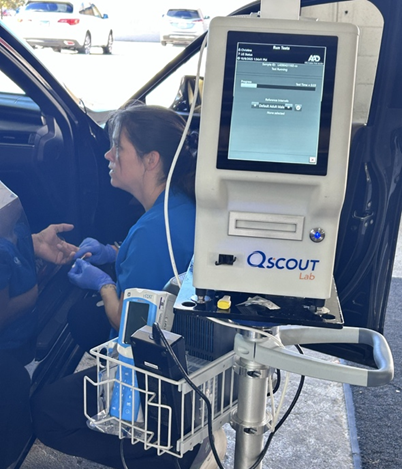
Medical professional assisting patient in car


AI is central to this transformation. A BARDA-supported test, developed by Ad Astra Diagnostics (AAD), shows the power of AI-enabled diagnostics in action. In late 2023, AAD received FDA 510(k) clearance for its QScout® RLD test, which analyzes a small blood sample using AI-powered digital imagery. When inserted into the QScout® Lab analyzer, advanced algorithms evaluate cellular morphology in under three minutes—delivering rapid insight into patient status at the point of need.

AAD is now preparing the next-generation QScout® CBC test on the second generation of the QScout® Lab platform, designed to accommodate both capillary and venous blood samples in a smaller, rugged format. With enhanced usability and portability, this system will be built for real-world conditions, supporting care in ambulances, rural clinics, urgent care centers, and disaster response environments. AI-driven interpretation of cellular imagery is also being expanded to support early identification of sepsis, further strengthening BARDA’s long-standing investment in infection severity diagnostics, resulting in three FDA-authorized products to date.

This matters deeply for communities. More than 85 percent of sepsis cases and 73 percent of pediatric sepsis cases are present upon admission to the hospital, indicating that patients are often progressing to severe illness before reaching the emergency room. Bringing advanced, AI-enabled diagnostics into community settings allows providers to identify high-risk patients earlier, communicate critical information ahead of hospital arrival, and initiate appropriate care without delay.

Imagine paramedics testing a blood sample in an ambulance and transmitting precise, AI-interpreted severity data from a complete blood count (CBC) to the emergency department before arrival . This level of real-time clinical insight is game-changing for patients and providers alike. The CBC test could help providers identify patients who are at risk for sepsis and enable providers to triage patients more effectively.

By investing in portable, AI-enabled host-response diagnostics, ASPR is strengthening national health security from the ground up and equipping communities with the tools to triage faster, manage resources more effectively, and improve patient outcomes before crises escalate. This is preparedness in action: bringing advanced technology directly to the front lines to protect Americans wherever they live and seek care.

How PAHPA Strengthened State and Local Resilience Through Workforce Flexibility

How PAHPA Strengthened State and Local Resilience Through Workforce Flexibility

Renewing the Flexible Workforce Authority That Empowers States to Save More Lives

As we look at the 20th anniversary of the Pandemic and All Hazards Preparedness Act (PAHPA), it’s easy to recognize some of the most tangible results that benefited State and local communities: new medicines, cutting-edge diagnostic tools, stockpiles filled with medical countermeasures, and ultimately, lives saved.

PAHPA's legacy extends beyond what we can see and touch. It extends beyond the programs, plans, and training we have built because of the authorities it granted. At its core, PAHPA gave us something even more fundamental: the legal authority to act when it matters most.

Because of PAHPA’s cycle for reauthorization, there are times when we can all collectively examine best practices and identify gaps in authorities to ensure we continue to move forward in providing the best support to those in need.

One example is when we had an outbreak of H1N1 in 2009. States and territories requested permission to use federally funded personnel to augment their response efforts. Unfortunately, our hands were tied. There was no authority to permit the use of those personnel for duties outside their original funding purposes. This was a technical gap in the baseline authorities — there was no emergency use clause or other consideration for flexible surge.

Expanding PAHPA’s Authorities

The 2013 Pandemic and All-Hazards Preparedness Reauthorization Act (PAHPRA) amended the Public Health Service Act (PHSA) to add much needed flexibility. Under this amendment, governors and tribal leaders could request temporary reassignment of federally funded public health personnel when a public health emergency was declared. In simple terms, upon request from a governor, tribal leader, or their designee, federally funded state and local personnel can be temporarily reassigned to immediately address emergency needs. 

The impact has been measurable.

Most states and U.S. territories have used this authority since 2020. Across jurisdictions, over 65,000 full-time equivalents have been reassigned to support disaster response operations. During declared public health emergencies, these personnel directly contributed to State and local resilience. Personnel disseminated vital communications to communities, connected health care systems with data, guidance, and medical supplies and equipment, enhanced coordination among public health, emergency management, and healthcare partners, staffed public hotlines, and performed many other duties to mitigate gaps in health care and community health needs.

Temporary reassignment does not create new positions. It allows jurisdictions to pivot the existing staff who are currently funded under the PHSA to the mission that matters most. It turns hands tied into helping hands within communities across the nation.

It also reduced reliance on the federal government. Communities best know their needs and this authority directly supports such efforts at low to no cost. Staff are already on the ground and have demonstrated the ability to quickly pivot under this authority to mitigate the impact of a public health emergency.

Congress included clear guardrails for use of this authority, and we appreciate the check and balance. For example, reassignments must be voluntary. They must occur within the geographic footprint of the declared emergency. Any reassignment beyond 30 days must be reauthorized. And importantly, the HHS Secretary must provide notice to Congress upon approval of an initial request or any extension. Flexibility and accountability exist side by side.

Streamlining Disaster Response

The expansion of PAHPA’s authorities reflects a broader principle that the Trump Administration has emphasized: disaster response works best when states are empowered to act. The threats facing state and local partners are not diminishing. Healthcare systems continue to operate under strain. Emerging biological threats require rapid coordination across jurisdictions. In that environment, workforce flexibility is not a luxury: It’s a necessity.

Over time, we’ve strengthened PAHPA to guarantee the authorities we need to respond proportionately in an emergency. We’ve used these authorities to empower state and local leaders so they can pivot their workforce quickly when conditions change.

Congress included a sunset date of September 2023 for this authority in the 2019 PAHPA reauthorization. The goal was to determine utilization of the authority. Every year since September 2023, the authority has been extended incrementally via funding bills.

Bottom line, temporary reassignment of personnel during disasters will give states the much-needed flexibility to move quickly and save lives when the next disaster strikes. History tells us that this authority is lifesaving. This is just one critical authority that ensures states have the flexibility they need to save more lives in the future.

Tranquil Passport Full-Scale Exercise: Strengthening U.S. Readiness to Safely Transport High-Consequence Infectious Disease Patients

Tranquil Passport Full-Scale Exercise: Strengthening U.S. Readiness to Safely Transport High-Consequence Infectious Disease Patients

In an increasingly interconnected world, infectious disease threats do not stop at borders. Preparing to safely move patients with highly dangerous infections—while protecting health care workers, responders, and the public—is a critical part of national health security. That challenge was the focus of the 2025 Tranquil Passport Full-Scale Exercise, a national preparedness effort led by the Administration for Strategic Preparedness and Response (ASPR), a division of the U.S. Department of Health and Human Services (HHS).

What Was the Tranquil Passport Exercise About?

Tranquil Passport, conducted June 24–27, 2025, tested the nation’s ability to safely transport multiple patients with high-consequence infectious diseases (HCIDs) from outside the U.S. to specialized treatment centers within the country.

This exercise marked the first operational deployment of HHS’s new Portable Biocontainment Unit (PBCU), a specially designed system that allows patients with dangerous infectious pathogens to be transported while minimizing risk to responders and the public. The PBCU’s patient care area can be configured to hold either two patients on stretchers or up to ten seated patients, making it a powerful new tool for outbreak response.

The scenario simulated a cluster of adult and pediatric patients being moved from Canada to multiple U.S. Regional Emerging Special Pathogen Treatment Centers, putting infectious disease patient transport plans, coordination processes, and logistics to the test.

Loading the PBCU on a Boeing 747 at Dulles International Airport

Who Participated?

The exercise brought together an unprecedented network of partners. More than 60 organizations took part, representing:

  • Federal agencies, including HHS, U.S. Department of State, U.S. Department of Transportation, U.S. Department of Justice, and the U.S. Department of War

  • The National Emerging Special Pathogens Training and Education Center (NETEC), the coordinating body for the National Special Pathogen System

  • Hospitals and emergency medical services agencies

  • State and local public health, emergency management, and law enforcement agencies

  • Airport emergency managers and aviation service providers

  • International partners in Canada

Exercise activities took place across six cities—Washington, District of Columbia; Baltimore, Maryland; New York City, New York; Raleigh, North Carolina; Atlanta, Georgia; and Toronto, Canada—at airports, hospitals, and emergency operations centers. This wide geographic footprint reflected the complexity of real-world responses that often span jurisdictions, regions, and national borders.

Mock patients and care team members onboard the PBCU enroute from Canada to the United States

Why Was This Exercise Important?

Past outbreaks—such as Ebola, Marburg, and Sudan virus disease—have shown that the ability to rapidly and safely transport infected patients can save lives and prevent further spread of disease. While earlier exercises validated international transport into the U.S., Tranquil Passport addressed a critical gap: domestic transport of multiple high-risk patients over long distances.

By exercising newly developed plans and equipment, the nation was able to:

  • Validate a first-of-its-kind federal capability for domestic HCID transport

  • Test decision-making and coordination during a complex, multi-patient mission

  • Identify strengths and gaps before a real emergency occurs

Exercises like Tranquil Passport help ensure that when a real outbreak happens, systems are already in place—and people are prepared to act.

A mock pediatric patient is transferred by an EMS team

What Impact Did the Exercise Have?

The exercise demonstrated that patient care teams could successfully treat and monitor patients inside the PBCU during transport, while maintaining strong safety practices. It also produced valuable insights that will strengthen future preparedness, including opportunities to:

  • Expand and train specialized transport teams

  • Enhance health and safety protections for responders

  • Improve coordination and communication across agencies and regions

  • Clarify roles, responsibilities, and decision-making processes

  • Optimize patient care, including support for children and other high-risk patients

These lessons will directly inform improvements to national plans, training programs, and operational procedures.

Looking Ahead

The Tranquil Passport exercise showed what is possible when agencies and partners work together toward a shared goal: protecting lives during the most challenging public health emergencies. By testing capabilities before they are needed, HHS and its partners are strengthening the nation’s readiness to respond swiftly, safely, and effectively to future infectious disease threats.

MRC and ASPR TRACIE Strengthen Partnership to Boost State and Local Preparedness

MRC and ASPR TRACIE Strengthen Partnership to Boost State and Local Preparedness

ASPR’s Office of Medical Reserve Corps (OMRC) and Technical Resources, Assistance Center, and Information Exchange (TRACIE) are collaborating on a one-stop knowledge center that strengthens State and local resilience. This new hub will host resources that Medical Reserve Corps (MRC) unit leaders and volunteers can use as they work to fill gaps in their community’s emergency preparedness, response, and recovery operations.

Under Executive Order 14239, “Achieving Efficiency through State and Local Preparedness,” the Administration for Strategic Preparedness and Response (ASPR) is evaluating existing programs and resources to ensure State and local partners are resilient in the face of disasters. Response starts locally; communities understand their specific needs and can react immediately to emerging threats.

Once the new hub launches, users will have easy access to curated tip sheets, operational tools, courses, and exercises. This information will specifically benefit MRC units. The TRACIE Team will expand the existing Resource Library and 58 Topic Collections with new content targeted for unit leaders and volunteers. ASPR TRACIE will also develop a dedicated MRC page with links to original materials, such as planning considerations, guidance documents, and speaker series recordings. This new page will allow registered users to save favorites and select training courses to complete at their own pace.

I encourage MRC volunteers to join the ASPR TRACIE Information Exchange (IE). Membership will allow you to connect with your peers and participate in near-real time conversations about anticipated and ongoing health threats; share plans and other materials; and discuss promising practices. All of the conversations in the IE section take place in a secure, password-protected environment. The IE also offers a private group feature for subgroups of users, allowing them space to discuss sensitive topics and share plans and documents that cannot be shared with the broader IE community. OMRC and ASPR TRACIE will create several private groups for MRC leaders, units, and volunteers, beginning with one for state coordinators.

As always, if your MRC unit needs help, reach out to askasprtracie@hhs.gov and ask the question.

ASPR TRACIE and OMRC have shared goals: to serve, inform, and protect the nation. What will users get when these two programs work together? A powerhouse of partnership, aimed at putting actionable information in the hands of state and local residents, bolstering community resilience. ASPR continues to strengthen State and local capabilities and this hub is just one way to access information and strengthen planning.

As we prepare to launch this new resource this spring, the ASPR TRACIE and OMRC teams continue to collect materials for the new library. If you have a resource that your Medical Reserve Corps unit has used to help you prepare for disasters, respond effectively, or increase resilience, contact askasprtracie@hhs.gov.


About the Medical Reserve Corps

The Medical Reserve Corps (MRC) is a national network of 268,000 dedicated volunteers, organized locally in more than 700 units to improve the health and safety of their communities. The MRC recruits, trains, and activates volunteers to respond to community health and safety needs during emergencies.

In 2024 alone, MRC volunteers dedicated over 300,000 hours of service in the communities they serve, filling critical gaps in local health care systems. For example, MRC volunteers provided CPR training to other MRC volunteers and community members; supported the U.S. Army’s 250th birthday and other National Security Special Events; and responded to emergencies, including the flooding in Washington State, the flooding in Texas, and the Shooting at Brown University. To find out how MRC made a difference in your community, check out the 2024 MRC Activities and Impacts by State or Territory.

About ASPR TRACIE

ASPR TRACIE is a one-stop shop, to support access to information and technical assistance (TA) needs of health care coalitions, and health care entities and providers, emergency managers, public health practitioners, and others working in disaster medicine, health care system preparedness, and public health emergency preparedness. The team responds to TA requests during steady state and during response operations and has developed more than 550 resources to fill emergency preparedness knowledge gaps.

Over the last decade, ASPR TRACIE has become the go-to resource for health care emergency managers across the country. TRACIE assists more than 70,000 CMS providers/suppliers with meeting the requirements of the Emergency Preparedness Rule and accrediting organization standards. During disaster and public health emergencies, ASPR TRACIE serves as a virtual force multiplier, improving information access and minimizing duplication of effort.

Recognizing 20 Years of the Pandemic and All-Hazards Preparedness Act

Recognizing 20 Years of the Pandemic and All-Hazards Preparedness Act

A look back at a critical law responsible for safeguarding American public health

This year marks the 20th anniversary of the Pandemic and All-Hazards Preparedness Act (PAHPA). Signed into law in 2006, PAHPA established HHS’s lead role in public health emergencies, created the position of the Assistant Secretary for Preparedness and Response who leads the office now called the Administration for Strategic Preparedness and Response (ASPR), and supported critical programs like the Strategic National Stockpile (SNS) and the Biomedical Advanced Research and Development Authority (BARDA).

For two decades, PAHPA has helped the nation prepare for, respond to, and recover from disasters and public health emergencies.

Since ASPR was established, we have faced many challenges—from the Deepwater Horizon oil spill to infectious disease outbreaks that required rapid development of new medical countermeasures, to natural disasters like hurricanes, wildfires, and tornadoes that affected entire regions.

This anniversary is a time to reflect on how far we’ve come—and to prepare for what’s ahead.

As someone who has spent a career in emergency response, I’m proud to serve as Principal Deputy Assistant Secretary (PDAS) for Preparedness and Response. Time and again, ASPR teams have stepped up during crises to protect lives and support communities during some of their most difficult times.

Why PAHPA Matters

PAHPA was signed into law after Hurricane Katrina exposed major weaknesses in the nation’s healthcare infrastructure. Katrina was not just a storm—it caused long-lasting damage across the entire healthcare infrastructure. Hospitals were destroyed, evacuation routes were flooded, supply chains failed, and communities faced overlapping public health, environmental, energy, and safety crises.

PAHPA was designed to fix those gaps by creating a unity of command while consolidating federal nonmilitary public health and medical preparedness and response functions. The goal was simple but critical: help the nation do better when disasters threaten our healthcare system and public health.

During the H1N1 response, ASPR utilized existing authorities to lead coordination efforts across HHS and the interagency. HHS more broadly was analyzing the virus, disseminating information to researchers and public health officials, developing and shipping new tests to diagnose infections, and distributing antiviral drugs from the (SNS). While ASPR and HHS mitigated the potential spread, there were gaps. Local and State capabilities were overwhelmed.

Building Stronger Preparedness

PAHPA has been strengthened over time. In 2013, Congress re-authorized and updated the law based on lessons from the H1N1 flu pandemic, which hit children especially hard. These updates helped improve care for children during emergencies. The law was also expanded to better support older adults and people with disabilities.

The 2013 reauthorization also added important flexibility, allowing federally funded healthcare workers employed by states, localities, or tribes—such as nurses and lab staff—to be reassigned to support communities facing surge needs during declared public health emergencies.

Following major hurricanes that impacted Puerto Rico, the U.S. Virgin Islands, and the East Coast, PAHPA was reauthorized a second time focusing on flexibilities for the deployable response force – the National Disaster Medical System and the Medical Reserve Corps.

The 2019 reauthorization also addressed ongoing threats from Ebola and other highly contagious infectious diseases (HCID). ASPR helped establish what is now the National Special Pathogen System, including 13 regional treatment centers for special pathogen readiness. Because of that readiness, the United States has been able to respond to Ebola and other serious diseases—such as Zika, Marburg virus, and mPox— while citizens continue with their daily lives with minimal disruption.

Looking Ahead

This anniversary is not only a time to reflect—it’s a reminder to stay ready. Today’s threats are increasingly complex, from natural disasters and emerging diseases to cyber risks facing healthcare systems. That’s why PAHPA and ASPR’s mission remain so important.

To meet future challenges, ASPR recently released its 2026–2029 Strategic Plan. The plan supports key Trump Administration priorities like increasing state and local resiliency, enhancing government efficiency, and onshoring pharmaceutical manufacturing and production capabilities to Make America Healthy Again.

The lesson of the past 20 years is clear: strong preparedness today enables effective response tomorrow. As Congress considers reauthorizing PAHPA for the third time, we hope lessons learned continue to strengthen ASPR’s authorities—so we can keep protecting health and saving lives across the nation.

Stand Ready. Move Fast. Save Lives.

Stand Ready. Move Fast. Save Lives.

Looking Back on ASPR’s Actions in 2025 to Strengthen Health Security, Confront Emerging Health Threats, and Prepare the Nation

During my first year serving in the HHS Administration for Strategic Preparedness and Response, one thing is abundantly clear: uncertainty is not the exception – it's the operating environment. ASPR provided resources and support to communities during a steady stream of challenges: infectious disease outbreaks, natural disasters, fragile medical supply chains, and more.

ASPR has delivered landmark achievements in 2025, and these accomplishments reflect ASPR’s commitment to safeguarding the health of the American people while strengthening national security.

Advancing Medical Countermeasures and Pharmaceutical Supply Chain Resilience

We cannot face tomorrow’s health security challenges with yesterday’s medicines and pharmaceutical supply chains. Our direction from the Trump Administration is clear: innovate so we are better equipped to Make America Healthy again and onshore and strengthen the pharmaceutical manufacturing and production capabilities that our nation relies on.

In support of the Make America Healthy Again initiative, ASPR’s Biomedical Advanced Research and Development Authority achieved 10 new FDA approvals, bringing its cumulative total to 107 medical countermeasure approvals. These life-saving innovations span diagnostics, therapeutics, and vaccines and strengthen preparedness for chemical, biological, radiological, and nuclear (CBRN) threats, pandemic influenza, and emerging infectious diseases.

In alignment with Executive Order 14336 – Ensuring American Pharmaceutical Supply Chain Resilience, ASPR’s Center for Industrial Base Management and Supply Chain (IBMSC) has made major strides to establish pharmaceutical independence for the United States. In 2025, IBMSC began work to support the storage of critical and at-risk drugs identified as vital to national health and security.

To reduce dependence on foreign pharmaceutical supply chains, IBMSC invested over $1 billion in domestic manufacturing capacity with a special emphasis on utilizing new technologies such as on demand, on site production technology using artificial intelligence, machine learning, 3-D printing, and informatics.

Enhancing National Emergency Preparedness

Through teamwork, precision, and relentless preparation, ASPR ensured the nation was better prepared to face complex threats to our nation’s health.

ASPR led the Tranquil Passport Full-Scale Exercise, one of the most extensive infectious disease patient movement exercises ever conducted. More than 1,000 personnel from 70+ federal, state, local, international, and non-governmental organizations participated in this exercise to test and validate the nation’s ability to safely and securely transport patients with high-consequence infectious diseases to regional treatment centers, and to demonstrate capabilities of ASPR’s new Portable Biocontainment Unit (PBCU).

ASPR brought together 92% of the nation's directors of public health emergency preparedness (DPHPs) for a groundbreaking event between DPHPs and ASPR regional teams from across the country. The workshop and Open House, featuring 17 ASPR programs, gave participants a clear understanding of ASPR’s mission, resources, and capabilities. The event strengthened collaboration, promoted transparency, and enhanced collective preparedness, laying the foundation for future action-oriented workshops to advance jurisdictional resilience nationwide.

ASPR also manages the Strategic National Stockpile (SNS) to ensure lifesaving medicines and supplies are ready and quickly deliverable to affected communities. In 2025, the SNS began a nationwide effort to place medical countermeasures closer to the communities that depend on them by supporting state, local, tribal, and territorial (SLTT) partners in building and maintaining their own stockpiles. To strengthen readiness, the SNS held listening sessions with 613 SLTT partners and validated 22 SLTT warehouse facilities to ensure they can receive, stage, and store medical countermeasures during emergencies.

In addition, the SNS trained responders from all 10 regions, including 22 states, two territories and one tribal entity, at the SNS Operations Course held at FEMA’s Center for Domestic Preparedness. This past year, the SNS also responded to multiple real-world incidents, deploying mpox treatments, personal protective equipment and antiviral drugs for H5N1, a Federal Medical Station for flooding in Washington State, Marburg, and Ebola Zaire vaccine for laboratory workers, clinicians, emergency responders and other at-risk personnel.

ASPR’s Technical Resources, Assistance Center, and Information Exchange (ASPR TRACIE) continued to be the backbone of healthcare preparedness, providing more than 13,000 technical assistance responses and supporting over 70 active incidents in 2025. ASPR also trained over 740,000 individuals on how to support electricity-dependent and healthcare-dependent at-risk populations during emergencies.

Driving Effective Response and Recovery Operations

In 2025, ASPR’s mission demanded rapid action on multiple fronts: deploying expert teams of medical responders, supporting communities through disaster recovery, defending critical health systems from cyber threats, and confronting emerging diseases abroad before they impacted national public and medical health.

In 2025, ASPR deployed nearly 1,300 personnel, including medical personal from the National Disaster Medical System, to support emergent crises and high-profile national events. ASPR was activated for nine National Special Security Events (NSSEs) and five disaster incidents, ensuring expert support wherever and whenever it was needed.

Recovery and behavioral health teams were activated for nine missions, with two ongoing concurrently, providing essential mental health and community recovery services.

ASPR continued to advance national cybersecurity in health care—triaging over 1,500 cybersecurity incidents and monitoring more than 780 potential threat events to mitigate risks across the sector.

Notably, a cybersecurity breach occured in St. Croix that significantly disrupted the islands essential clinical systems demonstrated ASPR’s rapid-response capability to cyber threats impacting critical healthcare infrastructure. At the request of local and federal partners, ASPR's Disaster Telemedicine team devised a rapidly deployable solution to support ongoing hospital services and recovery efforts utilizing ASPR’s telemedicine resources. 

In 2025, ASPR supported global response operations, preventing several infectious disease threats from reaching U.S. shores. For example, ASPR:

  • Rawanda - Marburg

  • Delivered 100 treatment courses of an Ebola therapeutic, along with diagnostic tests and swabs, to the Democratic Republic of Congo (DRC).

  • Donated nearly 240,000 doses of monkeypox vaccine to six African nations and deployed over 550 therapeutic drugs to treat symptomatic patients.

  • Pledged up to 2,500 doses of an investigational Marburg vaccine and 25 doses of a Marburg therapeutic to Ethiopia in response to the ongoing outbreak.

Looking Ahead

ASPR advanced preparedness for, response to, and recovery from public health and medical disasters throughout 2025. From groundbreaking FDA approvals and supply chain investments to large-scale training initiatives and global countermeasure deployments, ASPR continues to build a resilient health security future for all Americans.

As we prepare to celebrate the 250th anniversary of this great country, whatever challenges we may face in 2026, ASPR will stand ready, move fast, and save lives.

Developing Treatments for the Front Lines: How ASPR Is Advancing the Next Generation of Overdose Treatments

Developing Treatments for the Front Lines: How ASPR Is Advancing the Next Generation of Overdose Treatments

During my 34 years of experience in emergency response, I've seen firsthand the devastation that illegal opioids leave behind—on minds, on bodies, and on entire communities. Today, that devastation continues to spread, and it's claiming lives at an alarming rate.

In 2024 alone, more than 54,000 Americans died from opioid overdoses. That's not just a statistic—it's the equivalent of losing the entire population of a city like Harrisonburg, Virginia, or Saratoga Springs, New York. It's the size of a major university campus. And behind every number is a name, a family, a future cut short.

This crisis has taken children from classrooms, parents from dinner tables, and neighbors from our communities. It has shaken our nation's sense of security. Today, HHS Secretary Kennedy's renewal of the public health emergency for the opioid crisis went into effect. In addition, the U.S. Department of Homeland Security has declared synthetic opioids and certain drug adulterants to be material threat—a clear signal that this is not just a public health emergency, but also a national security issue.

In our response, we're not just fighting the opioid public health emergency, we're fighting for the soul of our country, for the dignity of our people, and for the promise of a healthier tomorrow. We're supporting efforts through public-private partnerships that bring together the best of American science, ingenuity, and compassion.

At ASPR, we believe all lives are worth saving, and that no first responder should ever have to stand by helplessly because they lack the tools to intervene. That's why we're taking bold action.

Current FDA-approved treatments have saved countless people but do fail in cases where opioids are mixed with other illicit drugs. Through efforts within the Biomedical Advanced Research and Development Authority (BARDA), ASPR has partnered with Orexo US, Inc. to develop a new rescue nasal powder designed to treat overdoses involving drugs like xylazine and medetomidine illicitly mixed with fentanyl.

If successful, Orexo's new drug could give first responders a powerful new tool to save lives in situations where current treatments fall short. This is the kind of innovation that turns moments of crisis into moments of hope.

At ASPR, we are committed to Secretary Kennedy's goal to Make America Healthy Again (MAHA). That means treating drug overdose with urgency, science, and humanity. It means giving first responders the tools they need to save lives. It means never giving up on the often forgotten people and communities who've been hit hardest by this crisis.

If you or someone you know is struggling with substance use disorder, please don't wait. Help is available. Visit FindTreatment.gov to locate treatment options near you.

Together, we can build a future where no family has to lose a loved one to overdose—and where every American has a second chance at life.

Cutting Through the Red Tape: ASPR’s Regional Operation Teams Empowers Local Public Health Leaders

Cutting Through the Red Tape: ASPR’s Regional Operation Teams Empowers Local Public Health Leaders

All emergencies are local. When state, local, tribal, and territorial (SLTT) leaders are empowered to make key decisions about disaster response and recovery operations, communities benefit. 

On March 18, 2025, President Trump issued Executive Order 14239 as a clear mandate to reduce the complexity of federal disaster management policies and empower state and local leaders. The federal government offers many services that SLTT leaders can leverage to protect health and save lives. However, finding the right federal public health and medical resource to meet a community's need can be a challenge – that's where ASPR's Regional Operation teams comes in.

ASPR's Regional Operation teams, including its Regional Administrators (RAs) and Regional Emergency Coordinators (RECs), help cut through red tape. They serve as ASPR's representatives to federal, state, tribal and territorial healthcare officials. From preparedness planning to disaster exercises, through response and recovery operations, ASPR's RAs and RECs are situated across the country to provide support and help their SLTT partners navigate the wide array of public health and medical services that are available from the federal government.

Does this system work? According to our state partners, the answer is yes. We talked with 5 directors of public health preparedness (DPHP) from across the country to get their perspectives.

Sheryl Roub, Public Health Preparedness and Response Unit Manager at the Wyoming Department of Health, describes ASPR RAs and RECs as "strategic problem solvers." They serve as an important resource that helps states connect with federal resources, provide a critical perspective, and offer technical assistance. "RECs provide critical guidance and a broader perspective, especially when it comes to integrating federal assets into state responses." says Tim Wiedrich, Director of the Health Response and Licensure Section at the North Dakota Department of Health.

ASPR RECs help states face and address their most complex public health and medical challenges. "Radiation is one of those tricky spaces for states. We're much more comfortable planning for and responding to environmental threats," explained Jay Fiedler, Director of the Bureau of Emergency Preparedness, EMS, and Systems of Care for the Michigan Department of Health. However, Michigan is home to several nuclear power plants, so it is critical that the state is ready to respond to a radiation incident.

Fiedler relied on the perspective of his ASPR REC throughout the planning process for Cobalt 25, a federally sponsored radiation exercise. "Our REC was there from the beginning of a year-long planning process next to my state emergency management coordinator, all the way through the execution of the exercise. He was literally sitting in our state health Emergency Operation Center, right next to us, helping us to navigate those federal resources from a lot of different federal agencies that we're not used to working with…Our access to RECs helps us respond in the most meaningful and in the most complete way that we could."

ASPR RECs can also connect their partners with some unique federal public health and medical resources. When an anthrax outbreak was identified in a herd of cattle in Wyoming, the state reached out to their REC for support. The REC worked to help the state DPHP get the federal assistance needed. Working first through the HHS Secretary's Operations Center and then through the CDC Emergency Operations Center, the REC helped the state DPHP to find the right people at CDC to initiate a clinical evaluation. Following the evaluation, the state received doses of Cyfendus, a newly approved medical countermeasure, to protect the community. Cyfendus was delivered in just a few days, enabling the state to deploy the product to three sites that needed it. "This response could not have happened without all of the REC's help," explained Roub. "I know I can call on them at any time."

When major disasters strike, ASPR RECs are there to ensure the state knows which federal public health and medical resources are available and can help the states get the help they need. Paul Petersen, Director of the Emergency Preparedness Program for Tennessee's Department of Health, recalls that "RECs were instrumental during the Helene disaster, assisting with patient evacuations and resource coordination." For example, the ASPR RECs assisted state officials with activation of the Emergency Prescription Assistance Program (EPAP). EPAP was activated at the request of the state, helping disaster survivors get access to prescription medications, durable medical equipment, and more. "Just having that input from the RECs helped us pull together all of these pieces that we had in play to ensure people could get access to care," said Petersen.

At the national level, responses that trigger a Stafford Act declaration get the most attention, but state and local responders manage every single emergency that happens in their jurisdictions. ASPR RECs are there to help during both the big events and the smaller, more routine emergencies.

For example, a power outage in New Hampshire didn't make national headlines, but it did threaten patient health in the jurisdiction. As part of the state's response, Stephanie Locke, Bureau Chief for Emergency Preparedness, Response, and Recovery at the New Hampshire Department of Health and Human Services called her REC for support. The REC helped coordinate resources during the power outage. Locke worked with her local REC to identify available resources to help protect patient safety. Ultimately, the hospital didn't have to evacuate.

Empowered local leaders are the cornerstone of effective disaster response and recovery. ASPR RECs are vital allies, streamlining processes so SLTT partners can effectively manage disaster preparedness, response, and recovery operations. When federal public health and medical resources are needed by SLTT partners, RECs truly serve as the "front door to ASPR".

As we look ahead to 2026, we're excited to continue building on this strong partnership and working together to support communities nationwide for years to come. If you are a SLTT public health or emergency management professional, take the time to get to know your ASPR REC or RA. 

Looking for a way to connect? You can find their contact information right here.


Thanks to the following DPHPs for contributing their perspectives to this blog: Jay Fiedler (Michigan), Stephanie Loke (New Hampshire), Paul Petersen (Tennessee), Sheryl Roub (Wyoming), and Tim Wiedrich (North Dakota).

Planning to Bring Americans Home when Disaster Strikes: How ASPR and Japan Built a Model for Partnership and Preparedness

Planning to Bring Americans Home when Disaster Strikes: How ASPR and Japan Built a Model for Partnership and Preparedness

ASPR supports planning to ensure that Americans overseas are safe and supported when disasters strike. By building trusted partnerships with foreign governments and response agencies, ASPR ensures that if an international crisis unfolds, Americans located overseas can return to US soil.

Since 2018, ASPR has engaged with Japan's Ministry of Health, Labour and Welfare (MHLW) and the Japan Disaster Medical Assistance Team (DMAT) Secretariat to plan and prepare to support the return of American citizens from abroad during international crisis.

Building the Partnership to Strengthen Preparedness

Our work with our Japanese counterparts targets four key focus areas within ASPR's mission: partnership and collaboration, repatriation, large-scale combat operations (LSCO) preparedness, and DMAT interoperability.

In April 2018, ASPR hosted MHLW and the Japan DMAT Secretariat in Hawaii to discuss repatriation of Americans during crisis and demonstrate capabilities of the National Disaster Medical System (NDMS) in action. That meeting laid the groundwork for a durable relationship built on trust, transparency, and shared commitment to the mission and people we support.

Since then, ASPR has invested in efforts to advance preparedness and planning including joint training, routine engagement, and participation in Japan's national DMAT exercises. These efforts have not only increased mutual understanding, but we also now have robust plans in place and know that both nations are positioned to act swiftly and effectively when emergencies occur.

Repatriation of American Citizens

The Department of State (DOS) leads repatriation of all American citizens located abroad under their robust authorities. However, some aspects of repatriation are central to ASPR's mission, such as supporting health screening, quarantine and isolation, and providing life-saving care as these citizens return home. When natural disasters, health crises, or emergencies occur, Americans are often caught in the same conditions as host nations' populations. While host governments focus resources on their own citizens, ASPR ensures that Americans receive care and can return home safely.

This priority came into sharp focus during the early days of the COVID-19 pandemic. When the Diamond Princess cruise ship docked in Yokohama at the outset of the COVID-19 pandemic in February of 2020. 419 Americans, many elderly and dependent on medication, were among those stranded.

Thanks to years of prior engagement, coordination, and planning, MHLW formally requested U.S. NDMS DMAT support health screening and patient support on the ship. Within days, ASPR coordinated a DMAT deployment that stabilized patients and facilitated repatriation flights. Japan later affirmed that without this established trust, the deployment would not have been possible and would not have been as quick or efficient, potentially worsening the health of those in the Diamond Princess.

The Diamond Princess response demonstrated a core lesson: partnerships and plans built before a crisis enable decisive action when lives are at stake. These partnerships are core to preparing for the worst of days and ultimately result in saved lives during the disaster.

Preparing for Large Scale Combat Operations

While natural disasters are a frequent driver of international response, ASPR also plans for the possibility of large-scale combat operations (LSCO) affecting Americans overseas. In such situations, the Department of War rightly prioritizes the care of military personnel. Yet American civilians, such as tourists, business travelers, and long-term residents, face similar risks and require evacuation and medical support.

ASPR works closely with the Departments of State and War and host nations to develop pathways for the safe medical evacuation of Americans, and LSCO was included in the two JA NATIONAL DMAT exercises in 2025 ASPR attended Planning now for this complex mission ensures that non-military citizens will not be left behind in the chaos of conflict. NDMS teams are central to this mission, providing surge capacity and evacuation expertise when no other U.S. government resources are available.

Expanding Impact

ASPR's engagement and international collaboration with Japan are now part of a broader regional planning and preparedness effort. By joining multinational exercises and fostering collaboration with partners like Australia, Taiwan, Korea, and others, ASPR contributes to a growing network of interoperability and resiliency across the Indo-Pacific.

The Bottom Line

The partnership between ASPR and Japan shows what is possible when nations invest in trust and preparedness before disaster strikes. From the response to the Diamond Princess crisis to participation in multinational exercises, this collaboration has become a model for international medical cooperation.

As crises grow more complex, whether natural, manmade, or conflict-driven, ASPR's commitment to building strong global partnerships will remain essential. The lesson is clear: proactive engagement today lays the groundwork to bring Americans facing disasters and emergencies abroad home safely.

ASPR Blog Building a Resilient Nation Together: Reflecting on National Preparedness Month

ASPR Blog Building a Resilient Nation Together: Reflecting on National Preparedness Month

As National Preparedness Month comes to a close, I find myself reflecting not only on the progress we've made as a nation, but also on the moments that remind us why preparedness matters. Preparedness is not abstract. It's personal.

Preparedness is the difference between chaos and calm, between vulnerability and resilience. And it's built, piece by piece, by the dedication of communities, public servants, and citizens who refuse to be caught unready. Hospitals need to be prepared and remain open and meet the needs of their communities during disasters when access to health care is critical. Families need personal preparedness plans to ensure they can connect during and after disasters. Preparedness is not just about federal investments but should be a priority for everyone. No matter the emergency, we're united in our purpose: save lives, safeguard health, and recover with strength.

At ASPR, our mission is to strengthen that readiness and make it an everyday focus. Our work may begin in policy or planning, but its true measure is in lives saved and communities protected.

Strengthening America's Medical Supply Chains

We've all seen how fragile supply lines can put lives at risk, whether it was shortages of IV fluids after hurricanes or critical medications during disease outbreaks. That's why one of our most important commitments is to rebuild America's ability to produce life-saving medicines here at home.

Our mandate from President Trump is clear: ensure medicines and supplies that the American people need are produced here in the U.S. Through ASPR's Center for Industrial Base Manufacturing and Supply Chain (IBMSC), we're taking decisive action to onshore production of critical pharmaceuticals, safeguarding against the vulnerabilities we have endured in the past. From advancing automated sterile manufacturing systems to expanding facilities that produce essential medications, we're ensuring that when the next emergency strikes, our healthcare system and workers have the tools they need to stay safe and save lives.

This is about more than supply chains. It's about restoring trust, investing in domestic capacity, bringing jobs home to the US, and ensuring that, no matter what comes, America will stand ready.

Developing Cutting Edge Medical Countermeasures

Medical countermeasures don't appear overnight. They take vision, innovation, and partnership. For decades, BARDA has partnered with industry, building the tools clinicians need to save lives during disasters and emergencies. Through bold initiatives like DRIVe Ventures and the BARDA Accelerator Network, they've redefined what public-private partnership means.

The result? Over 100 medical products cleared, licensed, or approved to fight chemical, biological, radiological, or nuclear threats; emerging diseases; or drug-resistant infections. BARDA transforms science into readiness and resilience.

Strategic National Stockpile

In a crisis, seconds matter. The Strategic National Stockpile stands ready to deliver lifesaving countermeasures when states, tribal nations, territories and the largest metropolitan areas need them most. But no stockpile, no matter how well built, can succeed alone. It takes coordination. It takes training. And it takes readiness at every level.

That's why I'm calling on our state, local, tribal, and territorial partners: don't wait for the disaster to strike. Get trained. Get ready. The SNS offers free, online courses that can help you act fast when lives are on the line.

Take the time now. You'll want to be ready when disaster strikes.

Supporting Communities Through Regional Operations

Preparedness is forged in relationships long before disaster strikes. Our Regional Administrators and Emergency Coordinators live and work alongside the communities they serve. They are the ones who know the local emergency manager by name, who sit at the table during planning exercises, and who show up when the waters rise, the winds roar, or the earth shakes.

Because of them, coordination is not an afterthought; it's a lifeline. Their work ensures that when the call comes, the response is seamless, and help reaches those in need without delay.

Celebrating ASPR TRACIE's Decade of Service

This September also marked 10 years of ASPR's Technical Resources Assistance Center and Information Exchange (ASPR TRACIE), a milestone that speaks to the power of knowledge shared both before disaster strikes and in moments of urgency. When hospitals face patient surge, when emergency managers confront the unexpected, TRACIE has been there with evidence-based guidance, lessons learned, and practical tools to turn confusion into clarity.

For a decade, TRACIE has been more than a resource: it's been a partner in resilience, empowering communities across the country to prepare, respond, and recover.

Empowering Communities Through the Medical Reserve Corps

If preparedness has a heartbeat, it can be found in the volunteers of the Medical Reserve Corps (MRC). Ordinary citizens, doctors, nurses, teachers, neighbors, stepping forward to protect their communities in extraordinary ways.

From supporting shelters during hurricanes to lending comfort and care during wildfires, MRC volunteers embody the spirit of service. They remind us that preparedness is not only a government responsibility; it's a shared act of humanity.

Always Scanning the Horizon

Situational awareness is the foundation of readiness. It is the first step in any successful operation, and it is non-negotiable.

At the HHS Secretary's Operations Center, under the leadership of ASPR, we stand the watch. Twenty-four hours a day. Seven days a week. We scan the horizon for the next threat — before it strikes. We don't wait for the call.

When disaster looms or crisis strikes, we move fast. We deliver critical intelligence to decision-makers. We marshal resources. We prioritize the mission. And we execute with precision and purpose.

A Shared Commitment

National Preparedness Month has reminded us again that resilience is not built in a moment. Resilience is built over time, through commitment, education, sacrifice, service, and partnership.

When supply chains are secured, when communities are connected, when knowledge is shared, and when volunteers step forward, we're not just responding to disasters, we're shaping a stronger, safer nation.

Preparedness transforms fear into action, and uncertainty into resolve. And when we embrace it together, we ensure that no matter what lies ahead, America will stand ready.

Thank you for your commitment, your resilience, and your service to one another. Together, we will continue to protect lives, strengthen communities, and build the resilient nation our future demands.

Subscribe to Preparedness and Response