ASPR Blog Ushering in a New Era in Ambulatory Care: AI-Powered Rapid Blood Tests at the Point of Need
Most infections start and often worsen in the community, but most tests are confined to clinical and hospital laboratories. Bringing testing closer to the patient leads to faster diagnoses, allowing patients and front-line providers to take action faster. The impacts could be transformative for the delivery of care, especially during seasonal surges of respiratory viruses, pandemics, and disasters. That’s why BARDA continues to partner with industry to advance host-based diagnostics, and through a recent partnership is harnessing artificial intelligence (AI) to bring meaningful results to front-line providers in less than three minutes.
BARDA’s Host-Based Diagnostics Program is advancing a new generation of tests that harness the body’s biological response to infection. By decoding unique host-response signatures, these innovative blood tests provide rapid, actionable insight into infection severity, empowering clinicians with critical information when and where it matters most.
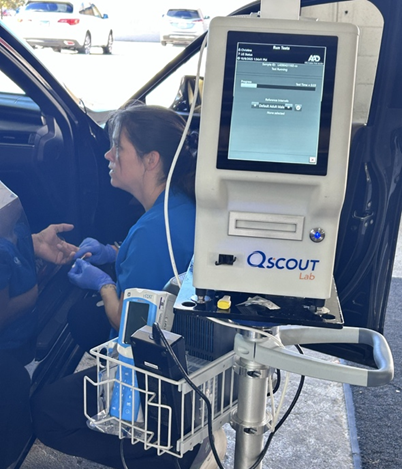
AI is central to this transformation. A BARDA-supported test, developed by Ad Astra Diagnostics (AAD), shows the power of AI-enabled diagnostics in action. In late 2023, AAD received FDA 510(k) clearance for its QScout® RLD test, which analyzes a small blood sample using AI-powered digital imagery. When inserted into the QScout® Lab analyzer, advanced algorithms evaluate cellular morphology in under three minutes—delivering rapid insight into patient status at the point of need.
AAD is now preparing the next-generation QScout® CBC test on the second generation of the QScout® Lab platform, designed to accommodate both capillary and venous blood samples in a smaller, rugged format. With enhanced usability and portability, this system will be built for real-world conditions, supporting care in ambulances, rural clinics, urgent care centers, and disaster response environments. AI-driven interpretation of cellular imagery is also being expanded to support early identification of sepsis, further strengthening BARDA’s long-standing investment in infection severity diagnostics, resulting in three FDA-authorized products to date.
This matters deeply for communities. More than 85 percent of sepsis cases and 73 percent of pediatric sepsis cases are present upon admission to the hospital, indicating that patients are often progressing to severe illness before reaching the emergency room. Bringing advanced, AI-enabled diagnostics into community settings allows providers to identify high-risk patients earlier, communicate critical information ahead of hospital arrival, and initiate appropriate care without delay.
Imagine paramedics testing a blood sample in an ambulance and transmitting precise, AI-interpreted severity data from a complete blood count (CBC) to the emergency department before arrival . This level of real-time clinical insight is game-changing for patients and providers alike. The CBC test could help providers identify patients who are at risk for sepsis and enable providers to triage patients more effectively.
By investing in portable, AI-enabled host-response diagnostics, ASPR is strengthening national health security from the ground up and equipping communities with the tools to triage faster, manage resources more effectively, and improve patient outcomes before crises escalate. This is preparedness in action: bringing advanced technology directly to the front lines to protect Americans wherever they live and seek care.