
ASPR Blog Ushering in a New Era in Ambulatory Care: AI-Powered Rapid Blood Tests at the Point of Need

ASPR Blog Ushering in a New Era in Ambulatory Care: AI-Powered Rapid Blood Tests at the Point of Need

Most infections start and often worsen in the community, but most tests are confined to clinical and hospital laboratories. Bringing testing closer to the patient leads to faster diagnoses, allowing patients and front-line providers to take action faster. The impacts could be transformative for the delivery of care, especially during seasonal surges of respiratory viruses, pandemics, and disasters. That’s why BARDA continues to partner with industry to advance host-based diagnostics, and through a recent partnership is harnessing artificial intelligence (AI) to bring meaningful results to front-line providers in less than three minutes.

BARDA’s Host-Based Diagnostics Program is advancing a new generation of tests that harness the body’s biological response to infection. By decoding unique host-response signatures, these innovative blood tests provide rapid, actionable insight into infection severity, empowering clinicians with critical information when and where it matters most.
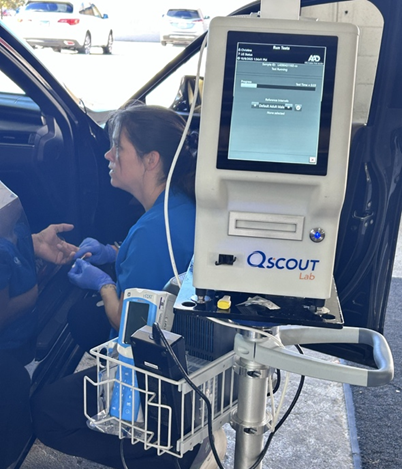
Medical professional assisting patient in car


AI is central to this transformation. A BARDA-supported test, developed by Ad Astra Diagnostics (AAD), shows the power of AI-enabled diagnostics in action. In late 2023, AAD received FDA 510(k) clearance for its QScout® RLD test, which analyzes a small blood sample using AI-powered digital imagery. When inserted into the QScout® Lab analyzer, advanced algorithms evaluate cellular morphology in under three minutes—delivering rapid insight into patient status at the point of need.

AAD is now preparing the next-generation QScout® CBC test on the second generation of the QScout® Lab platform, designed to accommodate both capillary and venous blood samples in a smaller, rugged format. With enhanced usability and portability, this system will be built for real-world conditions, supporting care in ambulances, rural clinics, urgent care centers, and disaster response environments. AI-driven interpretation of cellular imagery is also being expanded to support early identification of sepsis, further strengthening BARDA’s long-standing investment in infection severity diagnostics, resulting in three FDA-authorized products to date.

This matters deeply for communities. More than 85 percent of sepsis cases and 73 percent of pediatric sepsis cases are present upon admission to the hospital, indicating that patients are often progressing to severe illness before reaching the emergency room. Bringing advanced, AI-enabled diagnostics into community settings allows providers to identify high-risk patients earlier, communicate critical information ahead of hospital arrival, and initiate appropriate care without delay.

Imagine paramedics testing a blood sample in an ambulance and transmitting precise, AI-interpreted severity data from a complete blood count (CBC) to the emergency department before arrival . This level of real-time clinical insight is game-changing for patients and providers alike. The CBC test could help providers identify patients who are at risk for sepsis and enable providers to triage patients more effectively.

By investing in portable, AI-enabled host-response diagnostics, ASPR is strengthening national health security from the ground up and equipping communities with the tools to triage faster, manage resources more effectively, and improve patient outcomes before crises escalate. This is preparedness in action: bringing advanced technology directly to the front lines to protect Americans wherever they live and seek care.

New Cybersecurity Module in RISC 2.0 Toolkit Allows Healthcare and Public Health Organizations to Better Analyze Cyber Threats

New Cybersecurity Module in RISC 2.0 Toolkit Allows Healthcare and Public Health Organizations to Better Analyze Cyber Threats

The Administration for Strategic Preparedness and Response (ASPR) recently released a new cybersecurity module within the  Risk Identification and Site Criticality (RISC) 2.0 Toolkit . The RISC Toolkit is a free, web-based platform where public and private organizations within the healthcare and public health sector can conduct risk assessments by identifying threats, assessing vulnerabilities, determining consequences and criticality, and sharing findings with stakeholders. ASPR has integrated the new cybersecurity module into the existing RISC 2.0 platform, allowing facilities, health systems, and coalitions to analyze cyber risk alongside other hazards in one unified tool.

We acknowledge that cyber threats are growing more sophisticated, and we believe that cyber safety is patient safety. The cybersecurity module is our latest resource to assist our health care and public health partners in preventing the disruption of patient care and strengthening national health security. The new module guides users through a series of questions, in the style of a user-friendly self-assessment, about their policies and practices. Answers are scored against the  NIST Cybersecurity Framework (CSF) 2.0  and HPH Cybersecurity Performance Goals (CPGs) . This objective, standards-based approach helps organizations identify critical gaps, prioritize investments, and make informed decisions about risk mitigation. When health care organizations have the means to identify risks and vulnerabilities, they can implement strategies that minimize disruptions to patient care and strengthen preparedness and resilience.

The cyber module helps hospitals and healthcare systems better understand their cyber risks and areas where they may be particularly vulnerable. Once users better understand their risk profile, they can use existing field-proven tools like the CPGs and NIST CSF 2.0 to protect patient safety and increase the cyber resiliency of their organization. ASPR leads the HHS divisions and serves as the  Sector Risk Management Agency  for the Healthcare and Public Health Sector, and provides guidance and support to public and private partners to help enhance cybersecurity.

There are currently more than 3,500 health systems using the RISC toolkit to improve awareness of risks facing their facilities and communities, thus strengthening state and local resilience. In the tool, users enter site-specific data points through a series of questions. This information is then combined with data from 14 national databases, including the FBI crime and United States Geological Survey (USGS) earthquake databases, to provide a comprehensive assessment of threats and hazards resulting in an objective data-driven risk score for the facility. This allows organizations to better target capital investments and efforts to minimize the effects of natural disasters, security breaches, or other potential hazards to help lower risks to their facilities, staff and patients. Consistent analysis of these data creates a consistent method for assessing risk.

We must acknowledge that cyber safety is patient safety. The new RISC toolkit cybersecurity module will help our partners understand what is needed to strengthen their resilience and we strongly encourage them to take advantage of it.

How PAHPA Strengthened State and Local Resilience Through Workforce Flexibility

How PAHPA Strengthened State and Local Resilience Through Workforce Flexibility

Renewing the Flexible Workforce Authority That Empowers States to Save More Lives

As we look at the 20th anniversary of the Pandemic and All Hazards Preparedness Act (PAHPA), it’s easy to recognize some of the most tangible results that benefited State and local communities: new medicines, cutting-edge diagnostic tools, stockpiles filled with medical countermeasures, and ultimately, lives saved.

PAHPA's legacy extends beyond what we can see and touch. It extends beyond the programs, plans, and training we have built because of the authorities it granted. At its core, PAHPA gave us something even more fundamental: the legal authority to act when it matters most.

Because of PAHPA’s cycle for reauthorization, there are times when we can all collectively examine best practices and identify gaps in authorities to ensure we continue to move forward in providing the best support to those in need.

One example is when we had an outbreak of H1N1 in 2009. States and territories requested permission to use federally funded personnel to augment their response efforts. Unfortunately, our hands were tied. There was no authority to permit the use of those personnel for duties outside their original funding purposes. This was a technical gap in the baseline authorities — there was no emergency use clause or other consideration for flexible surge.

Expanding PAHPA’s Authorities

The 2013 Pandemic and All-Hazards Preparedness Reauthorization Act (PAHPRA) amended the Public Health Service Act (PHSA) to add much needed flexibility. Under this amendment, governors and tribal leaders could request temporary reassignment of federally funded public health personnel when a public health emergency was declared. In simple terms, upon request from a governor, tribal leader, or their designee, federally funded state and local personnel can be temporarily reassigned to immediately address emergency needs. 

The impact has been measurable.

Most states and U.S. territories have used this authority since 2020. Across jurisdictions, over 65,000 full-time equivalents have been reassigned to support disaster response operations. During declared public health emergencies, these personnel directly contributed to State and local resilience. Personnel disseminated vital communications to communities, connected health care systems with data, guidance, and medical supplies and equipment, enhanced coordination among public health, emergency management, and healthcare partners, staffed public hotlines, and performed many other duties to mitigate gaps in health care and community health needs.

Temporary reassignment does not create new positions. It allows jurisdictions to pivot the existing staff who are currently funded under the PHSA to the mission that matters most. It turns hands tied into helping hands within communities across the nation.

It also reduced reliance on the federal government. Communities best know their needs and this authority directly supports such efforts at low to no cost. Staff are already on the ground and have demonstrated the ability to quickly pivot under this authority to mitigate the impact of a public health emergency.

Congress included clear guardrails for use of this authority, and we appreciate the check and balance. For example, reassignments must be voluntary. They must occur within the geographic footprint of the declared emergency. Any reassignment beyond 30 days must be reauthorized. And importantly, the HHS Secretary must provide notice to Congress upon approval of an initial request or any extension. Flexibility and accountability exist side by side.

Streamlining Disaster Response

The expansion of PAHPA’s authorities reflects a broader principle that the Trump Administration has emphasized: disaster response works best when states are empowered to act. The threats facing state and local partners are not diminishing. Healthcare systems continue to operate under strain. Emerging biological threats require rapid coordination across jurisdictions. In that environment, workforce flexibility is not a luxury: It’s a necessity.

Over time, we’ve strengthened PAHPA to guarantee the authorities we need to respond proportionately in an emergency. We’ve used these authorities to empower state and local leaders so they can pivot their workforce quickly when conditions change.

Congress included a sunset date of September 2023 for this authority in the 2019 PAHPA reauthorization. The goal was to determine utilization of the authority. Every year since September 2023, the authority has been extended incrementally via funding bills.

Bottom line, temporary reassignment of personnel during disasters will give states the much-needed flexibility to move quickly and save lives when the next disaster strikes. History tells us that this authority is lifesaving. This is just one critical authority that ensures states have the flexibility they need to save more lives in the future.

Tranquil Passport Full-Scale Exercise: Strengthening U.S. Readiness to Safely Transport High-Consequence Infectious Disease Patients

Tranquil Passport Full-Scale Exercise: Strengthening U.S. Readiness to Safely Transport High-Consequence Infectious Disease Patients

In an increasingly interconnected world, infectious disease threats do not stop at borders. Preparing to safely move patients with highly dangerous infections—while protecting health care workers, responders, and the public—is a critical part of national health security. That challenge was the focus of the 2025 Tranquil Passport Full-Scale Exercise, a national preparedness effort led by the Administration for Strategic Preparedness and Response (ASPR), a division of the U.S. Department of Health and Human Services (HHS).

What Was the Tranquil Passport Exercise About?

Tranquil Passport, conducted June 24–27, 2025, tested the nation’s ability to safely transport multiple patients with high-consequence infectious diseases (HCIDs) from outside the U.S. to specialized treatment centers within the country.

This exercise marked the first operational deployment of HHS’s new Portable Biocontainment Unit (PBCU), a specially designed system that allows patients with dangerous infectious pathogens to be transported while minimizing risk to responders and the public. The PBCU’s patient care area can be configured to hold either two patients on stretchers or up to ten seated patients, making it a powerful new tool for outbreak response.

The scenario simulated a cluster of adult and pediatric patients being moved from Canada to multiple U.S. Regional Emerging Special Pathogen Treatment Centers, putting infectious disease patient transport plans, coordination processes, and logistics to the test.

Loading the PBCU on a Boeing 747 at Dulles International Airport

Who Participated?

The exercise brought together an unprecedented network of partners. More than 60 organizations took part, representing:

  • Federal agencies, including HHS, U.S. Department of State, U.S. Department of Transportation, U.S. Department of Justice, and the U.S. Department of War

  • The National Emerging Special Pathogens Training and Education Center (NETEC), the coordinating body for the National Special Pathogen System

  • Hospitals and emergency medical services agencies

  • State and local public health, emergency management, and law enforcement agencies

  • Airport emergency managers and aviation service providers

  • International partners in Canada

Exercise activities took place across six cities—Washington, District of Columbia; Baltimore, Maryland; New York City, New York; Raleigh, North Carolina; Atlanta, Georgia; and Toronto, Canada—at airports, hospitals, and emergency operations centers. This wide geographic footprint reflected the complexity of real-world responses that often span jurisdictions, regions, and national borders.

Mock patients and care team members onboard the PBCU enroute from Canada to the United States

Why Was This Exercise Important?

Past outbreaks—such as Ebola, Marburg, and Sudan virus disease—have shown that the ability to rapidly and safely transport infected patients can save lives and prevent further spread of disease. While earlier exercises validated international transport into the U.S., Tranquil Passport addressed a critical gap: domestic transport of multiple high-risk patients over long distances.

By exercising newly developed plans and equipment, the nation was able to:

  • Validate a first-of-its-kind federal capability for domestic HCID transport

  • Test decision-making and coordination during a complex, multi-patient mission

  • Identify strengths and gaps before a real emergency occurs

Exercises like Tranquil Passport help ensure that when a real outbreak happens, systems are already in place—and people are prepared to act.

A mock pediatric patient is transferred by an EMS team

What Impact Did the Exercise Have?

The exercise demonstrated that patient care teams could successfully treat and monitor patients inside the PBCU during transport, while maintaining strong safety practices. It also produced valuable insights that will strengthen future preparedness, including opportunities to:

  • Expand and train specialized transport teams

  • Enhance health and safety protections for responders

  • Improve coordination and communication across agencies and regions

  • Clarify roles, responsibilities, and decision-making processes

  • Optimize patient care, including support for children and other high-risk patients

These lessons will directly inform improvements to national plans, training programs, and operational procedures.

Looking Ahead

The Tranquil Passport exercise showed what is possible when agencies and partners work together toward a shared goal: protecting lives during the most challenging public health emergencies. By testing capabilities before they are needed, HHS and its partners are strengthening the nation’s readiness to respond swiftly, safely, and effectively to future infectious disease threats.

Stand Ready. Move Fast. Save Lives.

Stand Ready. Move Fast. Save Lives.

Looking Back on ASPR’s Actions in 2025 to Strengthen Health Security, Confront Emerging Health Threats, and Prepare the Nation

During my first year serving in the HHS Administration for Strategic Preparedness and Response, one thing is abundantly clear: uncertainty is not the exception – it's the operating environment. ASPR provided resources and support to communities during a steady stream of challenges: infectious disease outbreaks, natural disasters, fragile medical supply chains, and more.

ASPR has delivered landmark achievements in 2025, and these accomplishments reflect ASPR’s commitment to safeguarding the health of the American people while strengthening national security.

Advancing Medical Countermeasures and Pharmaceutical Supply Chain Resilience

We cannot face tomorrow’s health security challenges with yesterday’s medicines and pharmaceutical supply chains. Our direction from the Trump Administration is clear: innovate so we are better equipped to Make America Healthy again and onshore and strengthen the pharmaceutical manufacturing and production capabilities that our nation relies on.

In support of the Make America Healthy Again initiative, ASPR’s Biomedical Advanced Research and Development Authority achieved 10 new FDA approvals, bringing its cumulative total to 107 medical countermeasure approvals. These life-saving innovations span diagnostics, therapeutics, and vaccines and strengthen preparedness for chemical, biological, radiological, and nuclear (CBRN) threats, pandemic influenza, and emerging infectious diseases.

In alignment with Executive Order 14336 – Ensuring American Pharmaceutical Supply Chain Resilience, ASPR’s Center for Industrial Base Management and Supply Chain (IBMSC) has made major strides to establish pharmaceutical independence for the United States. In 2025, IBMSC began work to support the storage of critical and at-risk drugs identified as vital to national health and security.

To reduce dependence on foreign pharmaceutical supply chains, IBMSC invested over $1 billion in domestic manufacturing capacity with a special emphasis on utilizing new technologies such as on demand, on site production technology using artificial intelligence, machine learning, 3-D printing, and informatics.

Enhancing National Emergency Preparedness

Through teamwork, precision, and relentless preparation, ASPR ensured the nation was better prepared to face complex threats to our nation’s health.

ASPR led the Tranquil Passport Full-Scale Exercise, one of the most extensive infectious disease patient movement exercises ever conducted. More than 1,000 personnel from 70+ federal, state, local, international, and non-governmental organizations participated in this exercise to test and validate the nation’s ability to safely and securely transport patients with high-consequence infectious diseases to regional treatment centers, and to demonstrate capabilities of ASPR’s new Portable Biocontainment Unit (PBCU).

ASPR brought together 92% of the nation's directors of public health emergency preparedness (DPHPs) for a groundbreaking event between DPHPs and ASPR regional teams from across the country. The workshop and Open House, featuring 17 ASPR programs, gave participants a clear understanding of ASPR’s mission, resources, and capabilities. The event strengthened collaboration, promoted transparency, and enhanced collective preparedness, laying the foundation for future action-oriented workshops to advance jurisdictional resilience nationwide.

ASPR also manages the Strategic National Stockpile (SNS) to ensure lifesaving medicines and supplies are ready and quickly deliverable to affected communities. In 2025, the SNS began a nationwide effort to place medical countermeasures closer to the communities that depend on them by supporting state, local, tribal, and territorial (SLTT) partners in building and maintaining their own stockpiles. To strengthen readiness, the SNS held listening sessions with 613 SLTT partners and validated 22 SLTT warehouse facilities to ensure they can receive, stage, and store medical countermeasures during emergencies.

In addition, the SNS trained responders from all 10 regions, including 22 states, two territories and one tribal entity, at the SNS Operations Course held at FEMA’s Center for Domestic Preparedness. This past year, the SNS also responded to multiple real-world incidents, deploying mpox treatments, personal protective equipment and antiviral drugs for H5N1, a Federal Medical Station for flooding in Washington State, Marburg, and Ebola Zaire vaccine for laboratory workers, clinicians, emergency responders and other at-risk personnel.

ASPR’s Technical Resources, Assistance Center, and Information Exchange (ASPR TRACIE) continued to be the backbone of healthcare preparedness, providing more than 13,000 technical assistance responses and supporting over 70 active incidents in 2025. ASPR also trained over 740,000 individuals on how to support electricity-dependent and healthcare-dependent at-risk populations during emergencies.

Driving Effective Response and Recovery Operations

In 2025, ASPR’s mission demanded rapid action on multiple fronts: deploying expert teams of medical responders, supporting communities through disaster recovery, defending critical health systems from cyber threats, and confronting emerging diseases abroad before they impacted national public and medical health.

In 2025, ASPR deployed nearly 1,300 personnel, including medical personal from the National Disaster Medical System, to support emergent crises and high-profile national events. ASPR was activated for nine National Special Security Events (NSSEs) and five disaster incidents, ensuring expert support wherever and whenever it was needed.

Recovery and behavioral health teams were activated for nine missions, with two ongoing concurrently, providing essential mental health and community recovery services.

ASPR continued to advance national cybersecurity in health care—triaging over 1,500 cybersecurity incidents and monitoring more than 780 potential threat events to mitigate risks across the sector.

Notably, a cybersecurity breach occured in St. Croix that significantly disrupted the islands essential clinical systems demonstrated ASPR’s rapid-response capability to cyber threats impacting critical healthcare infrastructure. At the request of local and federal partners, ASPR's Disaster Telemedicine team devised a rapidly deployable solution to support ongoing hospital services and recovery efforts utilizing ASPR’s telemedicine resources. 

In 2025, ASPR supported global response operations, preventing several infectious disease threats from reaching U.S. shores. For example, ASPR:

  • Rawanda - Marburg

  • Delivered 100 treatment courses of an Ebola therapeutic, along with diagnostic tests and swabs, to the Democratic Republic of Congo (DRC).

  • Donated nearly 240,000 doses of monkeypox vaccine to six African nations and deployed over 550 therapeutic drugs to treat symptomatic patients.

  • Pledged up to 2,500 doses of an investigational Marburg vaccine and 25 doses of a Marburg therapeutic to Ethiopia in response to the ongoing outbreak.

Looking Ahead

ASPR advanced preparedness for, response to, and recovery from public health and medical disasters throughout 2025. From groundbreaking FDA approvals and supply chain investments to large-scale training initiatives and global countermeasure deployments, ASPR continues to build a resilient health security future for all Americans.

As we prepare to celebrate the 250th anniversary of this great country, whatever challenges we may face in 2026, ASPR will stand ready, move fast, and save lives.

Subscribe to Health Security