Property CSS Value
height-card-lg

PHEMCE Structure and Function

PHEMCE Structure and Function

Public Health and Emergency Medical Countermeasures Enterprise Strategy and Implementation Plan 2024

The PHEMCE is an interagency partnership of federal MCM experts who collaborate across sectors to protect the U.S. population from public health emergencies that require the availability and timely provision of effective MCMs. The PHEMCE exists to support a cohesive federal process for MCM development, acquisition, distribution, and dispensing, bridging gaps in the country's MCM portfolio. The PHEMCE does not direct or oversee plans, programs, and resources of other Departments or Agencies for medical countermeasures but rather develops recommendations that agencies may implement based on funding availability. Federal agency strategic priorities — including the work of the PHEMCE — should align with national strategies, such as the National Security Strategy, National Biodefense Strategy, and National Health Security Strategy.
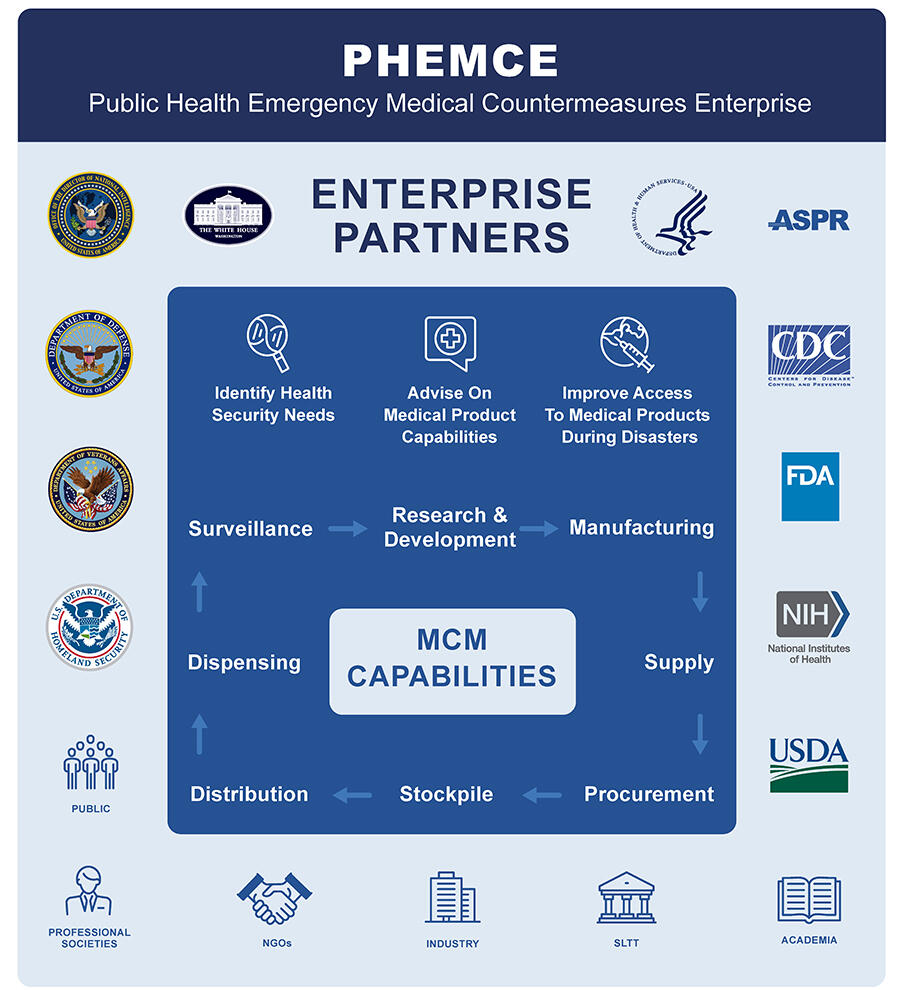
PHEMCE Enterprise Partners infographic
Figure 1. Medical Countermeasure Preparedness Partners


Co-chaired by the Assistant Secretary for Preparedness and Response (the ASPR) and the Director of the White House Office of Pandemic Preparedness and Response Policy (OPPR),1 PHEMCE membership includes the Director of the Centers for Disease Control and Prevention (CDC), Director of the National Institutes of Health, Commissioner of the U.S. Food and Drug Administration, Secretary of Defense, Secretary of Homeland Security, Secretary of Agriculture, Secretary of Veterans Affairs, and the Director of National Intelligence. PHEMCE representatives also include the Director of the Center for the Biomedical Advanced Research and Development Authority (BARDA), the Director of the Center for the Strategic National Stockpile (SNS), the Director of the National Institute of Allergy and Infectious Diseases (NIAID) and the Director of the Office of Readiness and Response. A principal official for each agency coordinates within their respective organizations to contribute technical expertise to PHEMCE's mission space. As the principal advisor to the HHS Secretary on federal public health and medical preparedness and response, the ASPR evaluates and synthesizes recommendations from the PHEMCE and presents them to the HHS Secretary. While ASPR leads each function outlined in the PHS Act, the PHEMCE ensures coordinated action across USG agencies. It does so by identifying what is needed to protect the U.S. population, developing strategies, and making recommendations to address any gaps, vulnerabilities, and challenges. PHEMCE's harmonization of these efforts results in a well-coordinated portfolio of MCMs available when needed to respond to and mitigate the impacts of public health emergencies.

Subject matter experts and technical teams from across the member agencies bring together information regarding threats; early research and development (R&D); advanced R&D (including enabling technologies); monitoring and surveillance; manufacturing and supply chains; regulatory science; procurement and stockpiling; and the deployment, distribution, dispensing, administration, and utilization of MCMs. The PHEMCE does not recreate each of these functions but rather builds on the existing infrastructure for these activities to inform recommendations for the HHS Secretary. The statute also directs PHEMCE to solicit and consider input from SLTT public health departments and officials. CDC's ongoing epidemiologic, laboratory, clinical consultation, and state and local support work with SLTT and clinical partners address not just routine, day-to-day outbreak and event responses but also informs ongoing planning and need for scaling as part of broader preparedness activities. ASPR accomplishes this through routine engagement from ASPR regional offices, formalized webinars, and targeted partnerships. Engagement with partners at all levels of emergency response improves understanding of capability needs, which serves to optimize USG investments in a more meaningful MCM portfolio. Additionally, when appropriate, the PHEMCE works with HHS and USG partners to consider international aspects of its mission to support global health security and international coordination to ensure national health security.

PHEMCE Functions

Identify icon
Identify Needs to Protect the Nation 
PHEMCE will identify national health security needs, gaps in MCM preparedness and response, and challenges to addressing these needs. 

Develop icon
Develop Strategies to Address Gaps 
PHEMCE will optimize the USG's MCM portfolio by contemplating MCM logistics, deployment, distribution, dispensing, and utilization. 

Recommendations icon
Make Recommendations to the HHS Secretary 
PHEMCE will provide the ASPR with the necessary input they need to make recommendations to the Secretary and inform preparedness and response efforts. 


The PHEMCE produces three primary outputs: the Strategy and Implementation Plan (SIP), the Medical Countermeasure Preparedness Review (MCMPR), and the Multiyear Budget (MYB). The SIP and MYB are publicly available. The MCMPR is available for Congress, but due to sensitivities around quantities of stockpiled products, is distributed at FOUO classification and thus not available.

The Strategy and Implementation Plan (SIP) is developed in collaboration with PHEMCE leadership and describes PHEMCE's functions, accomplishments, and four main goals with objectives and key milestones that will mark progress during the next two years of implementation. The goals and objectives aim to encapsulate PHEMCE's overarching purpose and collaborative presence to convene an interagency body focused on public health emergency preparedness.

The Medical Countermeasure Preparedness Review (MCMPR), leverages partner agencies' technical expertise to inform an annual threat-based review of the Strategic National Stockpile (SNS) contents and other stockpiles. Technical experts evaluate existing Requirements, MCMs currently stockpiled or managed by the USG, and gaps in procurement and stockpiling for each high-priority threat. Based on this assessment, they formulate and propose changes and/or corrective actions to enhance the USG's preparedness posture.

A critical component of the MCMPR is to inform Congress when annual appropriations for procurement and stockpiling do not allow for replacement of all expiring product and procurement of new products to fulfill existing Requirements. Additionally, when funds are insufficient for the SNS to maintain current capabilities and absorb additional products, ASPR, in consultation with PHEMCE member agencies, must weigh considerable tradeoffs. Inability to replenish MCM stocks or add new and innovative products that are safer and more effective may ultimately translate to increasing levels of risk across the threat portfolios and reduce ASPR's ability to respond in the event of a public health emergency or disaster.

The Multiyear Budget (MYB) forecasts the funding required to conduct basic research, advanced R&D, regulatory review, procurement, stockpiling, and replenishment of the USG's civilian MCM products. The MYB is a professional judgement budget, meaning it is formulated irrespective of the competing priorities considered in the annual budget formulation process. This report is focused on HHS's MCM needs but may incorporate other Departments and Agencies in future iterations. 


1.PHS Act (42 U.S.C. ‌§ 300-10a) - Public Health Emergency Medical Countermeasures Enterprise. 

 

<-- Back Next --> 
 

Introduction

Introduction

Public Health and Emergency Medical Countermeasures Enterprise Strategy and Implementation Plan 2024


Section 2811(d) of the Public Health Service (PHS) Act (42 U.S. Code § 300hh–10) directs the Administration for Strategic Preparedness and Response (ASPR) to develop a "coordinated strategy and accompanying implementation plan for medical countermeasures to address chemical, biological, radiological, and nuclear threats." This plan is developed in consultation with the Public Health Emergency Medical Countermeasures Enterprise (PHEMCE) and is submitted to Congress biennially.

The PHEMCE was established by the U.S. Department of Health and Human Services (HHS) in 2006 and codified by Congress in 2019 to advance the country's MCM preparedness against CBRN and emerging infectious disease threats. MCMs include both pharmaceutical interventions (e.g., vaccines, antimicrobials, antidotes, antitoxins, or other therapies such as those that may target the host) and non-pharmaceutical interventions (e.g., medical devices – including diagnostics, life support products, personal protective equipment, decontamination systems, and clinical decision-making support tools), as well as other needed medical products that may be used to detect or assess, prevent, mitigate, or treat the adverse health effects of a public health emergency caused by a naturally occurring, accidental, or deliberate threat. 
 

 Vision icon

Vision

A coordinated medical countermeasure (MCM) enterprise that enables the nation to prepare for and respond to national health security threats

 Mission icon

Mission

To guide the USG MCM portfolio and enhance the nation's capabilities to prepare for and respond to national health security threats 
 

<-- Back Next --> 


Executive Summary

Executive Summary

Public Health and Emergency Medical Countermeasures Enterprise Strategy and Implementation Plan 2024
 

The 2024 Public Health Emergency Medical Countermeasures Enterprise (PHEMCE) Strategy and Implementation Plan (SIP) describes the PHEMCE's goals and objectives to improve the nation's medical countermeasure (MCM) preparedness against chemical, biological, radiological, and nuclear (CBRN) threats, including pandemic influenza and other emerging infectious diseases (EIDs). These goals were created in close collaboration with PHEMCE member agencies across the federal government. Aimed at establishing an ambitious agenda, these PHEMCE SIP goals include: 
 

  • Ensuring the U.S. government (USG) has defined the right MCM capabilities to respond to public health emergencies and disasters by reviewing the threat landscape, prioritizing those threats that represent the highest risks, and harmonizing USG capabilities.

  • Driving unified action toward developing and sustaining priority MCMs aligned with key USG strategies by improving information sharing, reducing duplication of efforts, and identifying critical gaps and priorities to support MCM capabilities, particularly in an era of budget austerity.

  • Optimizing collaborations with partners ensuring state, local, tribal, and territorial (SLTT), industry, and other stakeholders are ready to respond during public health emergencies and disasters.

  • Strengthening last-mile MCM efforts to enable a more coordinated and equitable MCM response to future public health emergencies and disasters by ensuring incorporation of last-mile capabilities into appropriate USG response plans, with a focus on at-risk individuals and historically underserved communities.

Looking forward, the PHEMCE aims to strengthen the national ability to respond to naturally occurring, accidental, and deliberate threats that could severely impact health, safety, and well-being of the entire U.S. population. Successful implementation of the PHEMCE goals and objectives will also help build a foundation for future work. 
 

Goal 1 
 

government icon

Ensuring USG has defined the right MCM capabilities to respond to public health emergencies and disasters

Learn More

Goal 2 
 

Unified action icon

Driving unified action toward developing and sustaining priority MCMs aligned with key USG strategies 
 

Learn More

Goal 3 
 

Optimizing 
collaborations with partners 
 

Learn More

Goal 4 
 

Strengthening 
lastmile MCM efforts 
 

Learn More

<-- Back Next -->


2023-2027 PHEMCE Multiyear Budget

2023-2027 PHEMCE Multiyear Budget

The Public Health Emergency Medical Countermeasures Enterprise Multiyear Budget for Fiscal Years 2023 – 2027 (PHEMCE Multiyear Budget) forecasts the funding required to conduct basic research, advanced research and development, regulatory review, procurement, stockpiling, and replenishment of the U.S. government’s civilian medical countermeasure products for FY 2023-2027. ASPR is required to submit an annual multiyear budget for the PHEMCE to Congress.

The 2023-2027 PHEMCE MYB projects an estimated overall funding need of $71.1 billion over the five-year period, an increase of $7.1 billion over the 2022 report. The report estimates a gap of $37.9 billion between the FY 2023 flat-level scenario and the projected five-year total need. 

While the figures are generally consistent with those provided in the 2022-2026 report, there are notable differences to highlight. Beyond the enacted FY 2023 levels, PHEMCE agencies identified the following activities to address existing preparedness gaps:

  • National Institutes of Health (NIH) will support activities to advance a robust pipeline of candidate medical countermeasures for the development of safe and effective products. For NIH, one of the largest spending estimates is for new products to address gaps in the broad-spectrum antimicrobial portfolio, including the advancement of a small molecule antibiotic product, epetraborole (EBO), for the treatment of acute melioidosis as the first indication sought, and then potentially later indications of other biothreat agents (e.g., Plague, Anthrax, and Tularemia). To fund these activities, NIH estimates a $442 million need above enacted levels in FY 2023.

  • ASPR's Center for the Biomedical Advanced Research and Development Authority (BARDA) will support the advanced development of medical countermeasures, including improvements to threat-agnostic technologies, pandemic influenza vaccines, and novel therapeutics. To fund these activities, BARDA estimates a $28.8 billion need above enacted levels in FY 2023.
  • ASPR's Center for the Strategic National Stockpile (SNS) will support the development and transition of 13 MCM candidates from BARDA's Project BioShield to stockpiling by the SNS by FY 2027. Increased funding needs, beginning in FY 2025, are driven by an Ebola therapeutic, a therapeutic in the radiation/nuclear portfolio, and a smallpox antiviral; the planned transition of an Ebola therapeutic in FY 2027 makes up over half of the delta between the flat level and the projected need. The smallpox expenditures are in order to backfill the SNS for the MCMs distributed during the mpox response. To support these activities, SNS estimates a $6.7 billion increase above the enacted levels in FY 2023. BARDA's successes in supporting the advanced development of a robust portfolio of products that received FDA approval, licensure, clearance, or authorization have not been commensurate with the SNS budget for products to transition to the stockpile successfully. In the absence of a transition path, products without sustainable commercial pathways are likely to be lost, costing USG not only the investments along the way but also the critical ability to build PHEMCE's preparedness posture against future threats. 
    In addition to the transition of products from development to procurement, the SNS is tasked with maintaining its current preparedness posture. This means the replenishment of existing supplies, including antimicrobials necessary for post-exposure prophylaxis as part of the anthrax portfolio and the sustainment of SNS's current level of preparedness and the procurement of additional smallpox vaccine and therapeutics in order to replace MCMs used during the mpox outbreak. 
  • Food and Drug Administration (FDA) will sustain its ability to foster the establishment of clear, scientifically supported regulatory pathways for MCMs as well as to fill critical scientific gaps that inform regulatory decision-making and support efforts to establish regulatory policies and mechanisms to facilitate the efficient use of available MCMs. To support these activities, FDA estimates a $769 million increase above enacted levels in FY 2023.
  • Centers for Disease Control and Prevention (CDC), while newly added to this year's report, represents both new and ongoing programs related to research and development activities and provides critical support functions that ensure access during emergencies. 
     
Download icon

Download the 2023-2027 PHEMCE Multiyear Budget


PHEMCE Priority Threats

PHEMCE Priority Threats


The PHEMCE will continue to address MCM needs to protect against high-priority threats. These may be determined by the Secretary of Homeland Security based on those deemed to pose a sufficient material threat affecting national security, or by PHEMCE leadership having the potential to threaten national health security. The PHEMCE high-priority threats are (in alphabetical order by threat area): 

Biological Threats

  • Bacillus anthracis (anthrax)* and multidrug resistant B. anthracis (MDR anthrax)*

  • Burkholderia mallei (glanders)* and Burkholderia pseudomallei (melioidosis)*

  • Clostridium botulinum toxin (botulism)*

  • Ebolavirus (Ebola hemorrhagic fever)*

  • Emerging infectious diseases

  • Francisella tularensis (tularemia)*

  • Marburgvirus (Marburg hemorrhagic fever)*

  • Pandemic influenza virus

  • Rickettsia prowazekii (typhus)*

  • Severe acute respiratory syndrome-related coronavirus (SARS-CoV) (including SARS-CoV-1 and -2)*

  • Variola virus (smallpox)*

  • Yersinia pestis (plague)*

Chemical Threats

  • Acetylcholinesterase inhibitor nerve agents*

  • Chlorine

  • Cyanide salts (potassium and sodium cyanide)*

  • Hydrogen cyanide*

  • Pharmaceutical based agents (including opioids)*

  • Phosgene

  • Vesicants*

Radiological and Nuclear* Threats

  • Radiological and nuclear agents*


(*) Indicates an identified material threat under section 319F-2(c)(2)(A)(ii) of the Public Health Service Act. 
 

(#) For emerging infectious disease threats, the PHEMCE prioritizes the below pathogen families or groups. Novel high consequence pathogens within these groups have the potential to emerge and result in a U.S. public health emergency requiring mobilization of Federal resources.

  • Orthomyxoviridae

  • Coronaviridae

  • Paramyxoviridae

  • Poxviridae

  • Flaviviridae

  • Filoviridae

  • Togaviridae

  • Arenaviridae

  • Antimicrobial Resistant Pathogens


PHEMCE Mission, Vision, and Function

PHEMCE Mission, Vision, and Function


The PHEMCE is an interagency partnership of federal medical countermeasure experts who collaborate across sectors to protect the U.S. population during public health emergencies that require the availability and timely provision of effective medical countermeasures. The PHEMCE exists to provide a cohesive federal process for medical countermeasure development, acquisition, distribution, and dispensing, bridging gaps in the country's medical countermeasure portfolio.

MCMs include both pharmaceutical interventions (e.g., vaccines, antimicrobials, antidotes, antitoxins, or other therapies such as those that may target the host) and nonpharmaceutical interventions (e.g., medical devices including diagnostics, life support products, personal protective equipment, decontamination systems, and clinical decision-making support tools), as well as other needed medical products that may be used to detect or assess, prevent, mitigate, or treat the adverse health effects of a public health emergency caused by a naturally occurring, accidental, or deliberate threat.

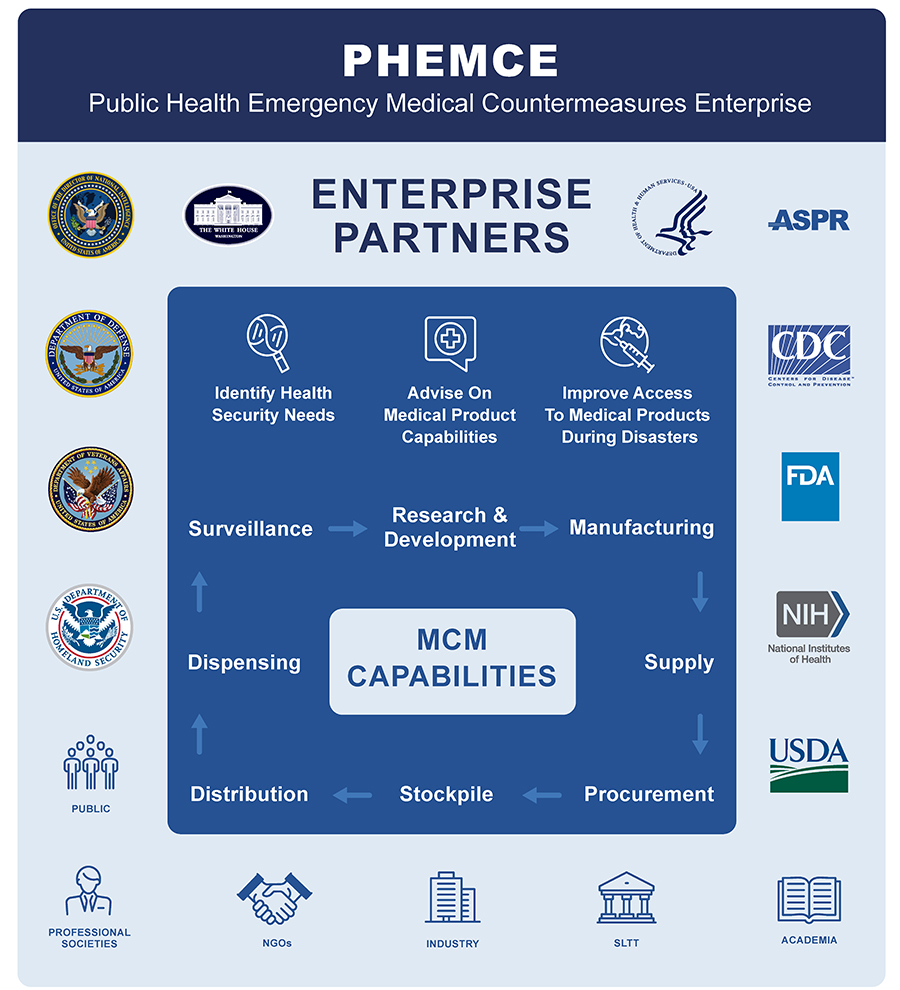
The PHEMCE, at its core, is responsible for 1) identifying what capabilities are needed to protect the U.S. population, 2) developing strategies to address gaps in our capabilities, and 3) making recommendations to the HHS Secretary to improve access to medical products during public health emergencies and disasters.

 Vision icon

Vision

A coordinated medical countermeasure (MCM) enterprise that enables the nation to prepare for and respond to national health security threats

Mission icon

Mission 

To guide the USG MCM portfolio and enhance the nation's capabilities to prepare for and respond to national health security threats 
 

Co-chaired by the Administrator and Assistant Secretary for Preparedness and Response (ASPR) and the Director of the Office of Pandemic Preparedness and Response Policy (OPPR), PHEMCE membership includes the Director of the Centers for Disease Control and Prevention, the Director of the National Institutes of Health, the Commissioner of the Food and Drug Administration, the Secretary of Defense, the Secretary of Homeland Security, the Secretary of Agriculture, the Secretary of Veterans Affairs, and the Director of National Intelligence.

The PHEMCE meets quarterly to discuss key issues and make recommendations. Additionally, subject matter experts and technical teams from across the member agencies meet routinely to bring together information. Information may touch on analyzing the current threats; early and advanced research and development, including enabling technologies; monitoring and surveillance; manufacturing; supply chains; regulatory science; procurement and stockpiling; and the deployment, distribution, dispensing, and administration of medical countermeasures.

The PHEMCE does not recreate each of these functions but rather builds on the existing infrastructure for these activities to inform recommendations for the Secretary of HHS. 
 

This partnership informs the plans and actions that ensure the right balance of medical countermeasures and improves availability and use of those medical countermeasures during disasters and emergencies. Improving the capabilities also enhances the nation's ability to nimbly respond to unknown and unforeseen threats. 
Infographic titled “PHEMCE — Public Health Emergency Medical Countermeasures Enterprise” showing enterprise partners and capabilities involved in preparing for and responding to public health emergencies. Federal partner logos (including HHS/ASPR, CDC, FDA, NIH, USDA, Department of Defense, Department of Veterans Affairs, Department of Homeland Security, and the White House) surround a central diagram of medical countermeasure (MCM) capabilities. The diagram highlights activities such as identifying health security needs, advising on medical product capabilities, improving access to medical products during disasters, surveillance, research and development, manufacturing, procurement, supply, stockpiling, distribution, and dispensing, along with collaboration from public, professional societies, NGOs, industry, state/local/tribal/territorial partners, and academia. 

The PHEMCE was established by the Department of Health and Human Services in 2006 and codified by Congress in 2019 to advance the country's medical countermeasure preparedness against chemical, biological, radiological, nuclear threats, and emerging infectious diseases (EID). 

Strategic National Stockpile Course Listing

Strategic National Stockpile Course Listing


Medical Countermeasure Management, Planning, and Training

Receive, Stage, and Store 
 

Risk Communications

Online Classes Available through CDC TRAIN

Several online courses are offered via CDC TRAIN, a tool which provides access to over 1300 courses developed by the Centers for Disease Control and Prevention programs, grantees, and other funded partners. Simply create an account and register for TRAIN to access the online courses below. 


CHEMPACK

CHEMPACK

CHEMPACK

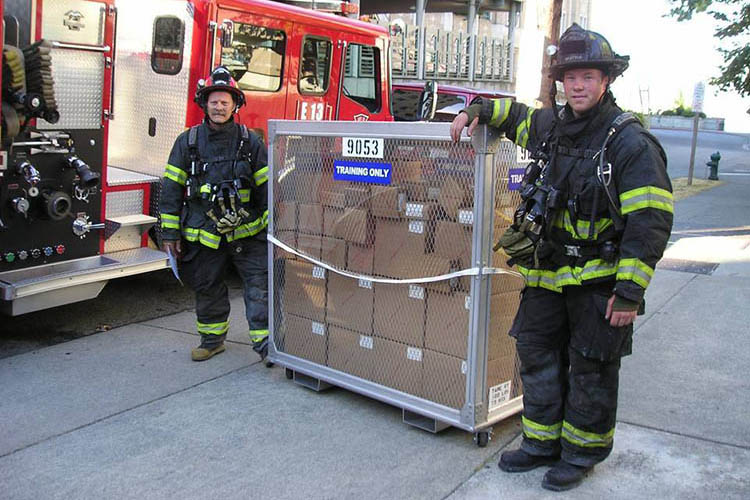
CHEMPACKs are containers of nerve agent antidotes placed in secure locations in local jurisdictions around the country to allow rapid response to a chemical incident. These medications treat the symptoms of nerve agent exposure and can be used even when the actual agent is unknown.

Because these antidotes must be administered quickly, the CHEMPACK team maintains approximately 1,974 containers strategically placed in approximately 1,33 0 locations in the United States and its territories. More than 90 percent of the U.S. population is within 1 hour of a CHEMPACK location. Most are located in hospitals or fire stations selected by local authorities to support a rapid hazmat response and can be accessed quickly if hospitals or first responders need them.

Nerve Agent EUA Information

On April 11, 2017, the U.S. Food and Drug Administration (FDA) issued an Emergency Use Authorization (EUA) to permit the emergency use of the 2 mg atropine auto-injector, manufactured by Rafa Laboratories, Ltd. On May 23, 2017, FDA amended the EUA to also permit the emergency use of pediatric strengths (i.e., 0.5 mg and 1 mg) of this atropine auto-injector. On January 24, 2018, FDA granted another EUA amendment to permit auto-injector administration through clothing. These products are included in CHEMPACK containers located across the United States. This specific atropine auto-injector is authorized for the initial treatment of symptoms of known or suspected poisoning in individuals exposed to nerve agents or certain insecticides (organophosphorus and/or carbamate). The original letter of authorization describes the scope and conditions of EUA that apply to all three strengths (0.5 mg, 1 mg and 2 mg) of this atropine auto-injector; the amendment letters are addenda to the original letter of authorization. The amended fact sheets dated January 24, 2018 (version 3) for healthcare providers and patients and caregivers are the current versions and available through FDA's EUA website.


Contact Us

For further questions or information about the Strategic National Stockpile, please email us at sns.ops@hhs.gov

SNS-held Ventilator Maintenance

SNS-held Ventilator Maintenance

The Strategic National Stockpile (SNS) holds an inventory of ventilators that can be deployed during a public health emergency if public health and healthcare facilities need supplemental ventilators to care for patients. These stockpiled devices for lifesaving care can be used as a short-term, stop-gap buffer when the immediate supply is not adequate.

The SNS is committed to the proper maintenance of its ventilators to ensure the devices are ready to deploy when needed.

Every ventilator in the SNS is serviced annually by a contracted commercial vendor. This is above and beyond the manufacturer's two-year service cycle recommendation. Service includes a full functions check, recertification in accordance with the original equipment manufacturer's service manual, and repairs, if needed.

Contact Us

For further questions or information about the Strategic National Stockpile, please email us at sns.ops@cdc.gov

Lisa Dillard

Lisa Dillard


Deputy Director
Center for the Strategic National Stockpile
Administration for Strategic Preparedness and Response
U.S. Department of Health and Human Services

Lisa Dillard

Lisa Dillard is the Deputy Director of the Center for the Strategic National Stockpile (SNS). In this role, she provides strategic leadership to advance the SNS emergency preparedness and response mission, ensuring operational readiness to support national biodefense priorities.

As a Senior Executive Service member, Dillard brings extensive emergency preparedness and response expertise. She previously served as chief of the SNS Information and Planning Branch—now the SNS Office of National Readiness and Response—where she led complex preparedness initiatives, operational planning, and large-scale response efforts. She has directed numerous SNS responses, including natural disasters, multiple pandemics, mpox, and H5N1, ensuring the effective distribution of critical medical countermeasures, supplies and equipment during public health crises. Her leadership was instrumental in integrating the private sector into public health emergency response operations, including the long-standing collaboration between the SNS and the Health Industry Distributors Association to strengthen medical supply chain resilience

Dillard began her tenure at the SNS in 2002, following a distinguished U.S. Army military intelligence officer career. Her assignments across the United States, South Korea, and Southwest Asia have shaped her strategic approach to national security and crisis management. She holds an accounting degree from North Carolina A&T State University. 


Contact Us 
 

For further questions or information about the Office of the Strategic National Stockpile, please email us at sns.ops@hhs.gov

Subscribe to USWDS Height Card Large (240px)