





PHEMCE Structure and Function
The PHEMCE is an interagency partnership of federal MCM experts who collaborate across sectors to protect the U.S. population from public health emergencies that require the availability and timely provision of effective MCMs. The PHEMCE exists to support a cohesive federal process for MCM development, acquisition, distribution, and dispensing, bridging gaps in the country's MCM portfolio. The PHEMCE does not direct or oversee plans, programs, and resources of other Departments or Agencies for medical countermeasures but rather develops recommendations that agencies may implement based on funding availability. Federal agency strategic priorities — including the work of the PHEMCE — should align with national strategies, such as the National Security Strategy, National Biodefense Strategy, and National Health Security Strategy.
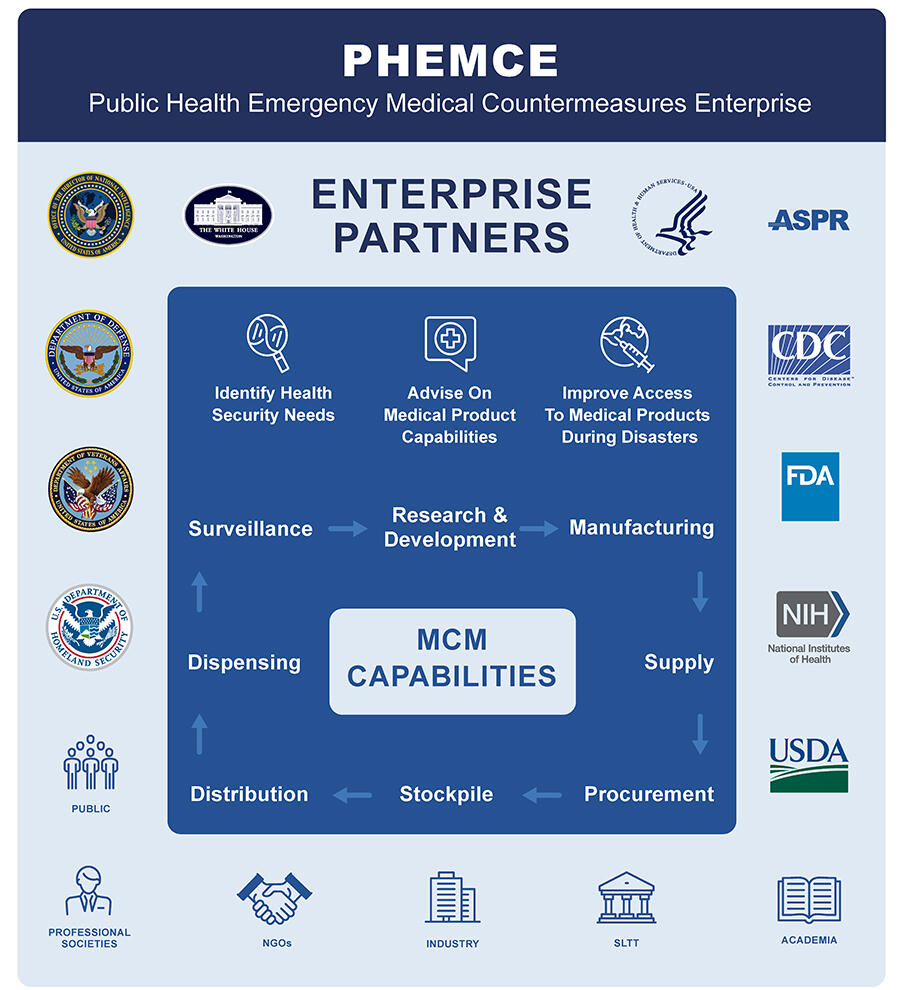
Co-chaired by the Assistant Secretary for Preparedness and Response (the ASPR) and the Director of the White House Office of Pandemic Preparedness and Response Policy (OPPR),1 PHEMCE membership includes the Director of the Centers for Disease Control and Prevention (CDC), Director of the National Institutes of Health, Commissioner of the U.S. Food and Drug Administration, Secretary of Defense, Secretary of Homeland Security, Secretary of Agriculture, Secretary of Veterans Affairs, and the Director of National Intelligence. PHEMCE representatives also include the Director of the Center for the Biomedical Advanced Research and Development Authority (BARDA), the Director of the Center for the Strategic National Stockpile (SNS), the Director of the National Institute of Allergy and Infectious Diseases (NIAID) and the Director of the Office of Readiness and Response. A principal official for each agency coordinates within their respective organizations to contribute technical expertise to PHEMCE's mission space. As the principal advisor to the HHS Secretary on federal public health and medical preparedness and response, the ASPR evaluates and synthesizes recommendations from the PHEMCE and presents them to the HHS Secretary. While ASPR leads each function outlined in the PHS Act, the PHEMCE ensures coordinated action across USG agencies. It does so by identifying what is needed to protect the U.S. population, developing strategies, and making recommendations to address any gaps, vulnerabilities, and challenges. PHEMCE's harmonization of these efforts results in a well-coordinated portfolio of MCMs available when needed to respond to and mitigate the impacts of public health emergencies.
Subject matter experts and technical teams from across the member agencies bring together information regarding threats; early research and development (R&D); advanced R&D (including enabling technologies); monitoring and surveillance; manufacturing and supply chains; regulatory science; procurement and stockpiling; and the deployment, distribution, dispensing, administration, and utilization of MCMs. The PHEMCE does not recreate each of these functions but rather builds on the existing infrastructure for these activities to inform recommendations for the HHS Secretary. The statute also directs PHEMCE to solicit and consider input from SLTT public health departments and officials. CDC's ongoing epidemiologic, laboratory, clinical consultation, and state and local support work with SLTT and clinical partners address not just routine, day-to-day outbreak and event responses but also informs ongoing planning and need for scaling as part of broader preparedness activities. ASPR accomplishes this through routine engagement from ASPR regional offices, formalized webinars, and targeted partnerships. Engagement with partners at all levels of emergency response improves understanding of capability needs, which serves to optimize USG investments in a more meaningful MCM portfolio. Additionally, when appropriate, the PHEMCE works with HHS and USG partners to consider international aspects of its mission to support global health security and international coordination to ensure national health security.
PHEMCE Functions

PHEMCE will identify national health security needs, gaps in MCM preparedness and response, and challenges to addressing these needs.

PHEMCE will optimize the USG's MCM portfolio by contemplating MCM logistics, deployment, distribution, dispensing, and utilization.

PHEMCE will provide the ASPR with the necessary input they need to make recommendations to the Secretary and inform preparedness and response efforts.
The PHEMCE produces three primary outputs: the Strategy and Implementation Plan (SIP), the Medical Countermeasure Preparedness Review (MCMPR), and the Multiyear Budget (MYB). The SIP and MYB are publicly available. The MCMPR is available for Congress, but due to sensitivities around quantities of stockpiled products, is distributed at FOUO classification and thus not available.
The Strategy and Implementation Plan (SIP) is developed in collaboration with PHEMCE leadership and describes PHEMCE's functions, accomplishments, and four main goals with objectives and key milestones that will mark progress during the next two years of implementation. The goals and objectives aim to encapsulate PHEMCE's overarching purpose and collaborative presence to convene an interagency body focused on public health emergency preparedness.
The Medical Countermeasure Preparedness Review (MCMPR), leverages partner agencies' technical expertise to inform an annual threat-based review of the Strategic National Stockpile (SNS) contents and other stockpiles. Technical experts evaluate existing Requirements, MCMs currently stockpiled or managed by the USG, and gaps in procurement and stockpiling for each high-priority threat. Based on this assessment, they formulate and propose changes and/or corrective actions to enhance the USG's preparedness posture.
A critical component of the MCMPR is to inform Congress when annual appropriations for procurement and stockpiling do not allow for replacement of all expiring product and procurement of new products to fulfill existing Requirements. Additionally, when funds are insufficient for the SNS to maintain current capabilities and absorb additional products, ASPR, in consultation with PHEMCE member agencies, must weigh considerable tradeoffs. Inability to replenish MCM stocks or add new and innovative products that are safer and more effective may ultimately translate to increasing levels of risk across the threat portfolios and reduce ASPR's ability to respond in the event of a public health emergency or disaster.
The Multiyear Budget (MYB) forecasts the funding required to conduct basic research, advanced R&D, regulatory review, procurement, stockpiling, and replenishment of the USG's civilian MCM products. The MYB is a professional judgement budget, meaning it is formulated irrespective of the competing priorities considered in the annual budget formulation process. This report is focused on HHS's MCM needs but may incorporate other Departments and Agencies in future iterations.
1.PHS Act (42 U.S.C. § 300-10a) - Public Health Emergency Medical Countermeasures Enterprise.