Official websites use .gov
A .gov website belongs to an official government organization in the United
States.
Secure .gov websites use HTTPS
A lock (
) or https:// means you’ve safely
connected to the .gov website. Share sensitive information only on official, secure websites.
A condition of NDMS coverage is the patient must be transported via Federal assets, processed through a Federal Coordinating Center (FCC), and referred to facilities or practitioners for definitive medical care. The NDMS tracks all NDMS federal patients who are transported via Federal assets and thus, are eligible for coverage under this program.
Authorized emergency response and disaster relief personnel responding to the public health emergency who suffer injuries or illnesses are also eligible for NDMS Definitive Care Program coverage.
Generally, any medically necessary service which is authorized under Medicare Part A, Medicare Part B or a State's Medicaid program is eligible for reimbursement as long as the NDMS federal patient sustained one of the following:
injuries or illnesses resulting directly from a specified public health emergency; or
injuries, illnesses, and conditions requiring essential medical services necessary to maintain a reasonable level of health temporarily not available as a result of the public health emergency; or
injuries or illnesses affecting authorized emergency response and disaster relief personnel responding to the public health emergency.
The NDMS Definitive Care Reimbursement Program coverage ends when one or more of the following conditions is met:
the patient's medically indicated treatment ends (maximum reimbursable duration of 30 days, unless otherwise directed);
the patient voluntarily refuses care;
thirty calendar days have elapsed from the date of the patient's evacuation/placement (unless otherwise directed); or
the patient is returned home or to the point of origin (or a fiscally comparable location) or to the patient's destination of choice.
The NDMS Reimbursement Program will pay primary under the following circumstances:
the patient is uninsured;
the patient is covered only by Medicaid; or
the patient is only covered by another payer of last resort.
Note: The NDMS Definitive Care Reimbursement Program does not supersede contracts that providers have with other payers which require the payer's reimbursement be accepted as payment in full (also referred to as "Assignment"). In these cases where the provider has agreed to accept Assignment from another payer, the NDMS Definitive Care Reimbursement Program will not make any secondary payments.
The NDMS Definitive Care Reimbursement Program will make no primary or secondary payments for patients with:
TRICARE coverage.
Medicare coverage.
Free care-eligible veterans treated in Veterans Affairs hospitals
A provider must currently participate in either the Medicare or the Medicaid program to be eligible for reimbursement. Eligible providers cannot be excluded, debarred, or suspended from participation in Medicare or any other federal healthcare program.
If you currently participate in the Medicare program, reimbursement rates will be determined using Medicare Part A and Part B payment policies.
If you do not participate in the Medicare program but do actively participate in your State's Medicaid program, reimbursement rates will be determined using your State's Medicaid payment policies. Payment Information Payments will only be made via electronic funds transfer by Federal Fiduciary on behalf of the NDMS. 1099 forms will be issued by Federal Fiduciary as well.
Payment Information
Payments will only be made via electronic funds transfer by Federal Fiduciary on behalf of the NDMS. 1099 forms will be issued by Federal Fiduciary as well.
Provider Registration
To be reimbursed under this program, each provider organization will be required to submit a Provider Registration form, a W-9 form and an ACH Vendor Enrollment form to Federal Fiduciary. These forms only need to be completed one-time even if your organization is submitting multiple claims on different dates. Although these forms do not have to be completed before a public health emergency occurs or before claims are submitted to the program, please note that payments cannot be released until all forms have been received.
Verify benefits first! If the patient has Medicare, Tricare or VA benefits. If so...
The patients' care should be billed through their Medicare, Tricare, or VA benefits.
Please DO NOT file a claim through the NDMS Definitive Care Reimbursement Program.
HOWEVER, if the patient has...
Coverage
Billing Action
Private Health Insurance or non-Federal Public Coverage other than Medicaid
Other insurance billed as primary payer. NDMS billed as secondary payer for any unreimbursed amounts not to exceed 110% of Medicare rate for Hospitals with MOA or 100% of Medicare rate for Practitioners.
Medicare
NDMS billed as primary payer.
Dual Eligible (Medicare and Medicaid)
Medicare is the primary payer. Medicaid is the Secondary payer. Facility will submit EOB to NDMS in order to receive the 10% Admin fee. NDMS payer of last resort.
Benefit examples listed above are claim eligible! Use the Claims Submission.
Claims Submission Checklist
Ensure the NDMS Definitive Car e Reimbursement Program has been activated.
Ensure the claim will fall under coverage guidelines.
Complete the Provider Registration forms, which includes:
W-9 Form
ACH Vendor Enrollment Form (Only fill in company and banking info)
NDMS Definitive Care Reimbursement Program Provider Enrollment Form
Complete the applicable claim forms:
Hospitals (CMS-1450)
Practitioners (CMS-1500)
Submit the claim and all Provider Registration Forms BEFORE the submission deadline by either.
Electronically via a claims clearinghouse service to payer code: NDMSA (HHS NATIONAL DISASTERMEDICAL SYSTEM-APPRIO)
NDMSJ29 (HHS NATIONAL DISASTER MEDICAL SYSTEM-J-29)
Providers should submit ALL claims electronically through a claims clearinghouse service to payer code NDMSJ29 (HHS National Disaster Medical System-J-29). For every electronic claim received, an electronic remittance advice will be returned, making payment reconciliation more efficient for providers.
This includes Secondary Claims submission for Coordination of Benefits (COB). After the primary insurance has processed the claim, include the remittance information from the primary payer in the 837 record. This helps streamline the process and ensures that all necessary information is available for the secondary payer.
If you are unable to submit your claims electronically, hard-copy claims may be submitted to J29 using industry-standard pre-printed claim forms:
Institutional claims must be submitted using the CMS-1450 (UB-04) claim form.
Professional claims must be submitted using the CMS-1500 claim form.
Dental claims must be submitted using the ADA Dental claim form.
COB Claims must include a detailed EOB including provider payments and remittance advice.
Mail: c/o Apprio 425 3rd Street, SW, Suite 600 Washington, DC 20024
For more information, please visit the NDMS Definitive Care Reimbursement Program. There you will find coverage guidelines, downloadable forms in PDF format and answers to FAQs!
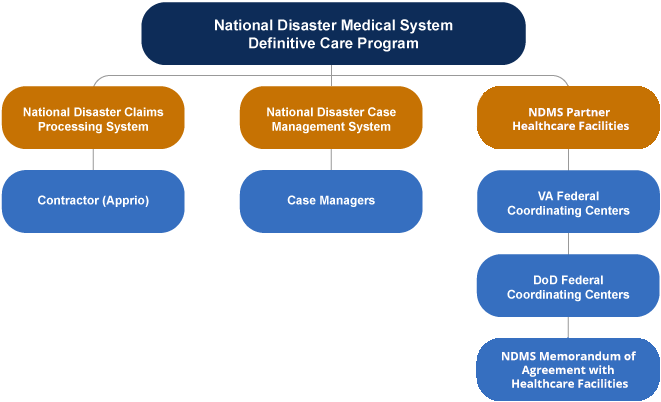
The NDMS Definitive Care Program can be d escribed as a three-pronged approach, without one, the other two components cannot function effectively.
The National Disaster Claims Processing System has been defined by Federal Register, Vol. 70, No. 225/Wednesday, November 23, 2005 . The primary purpose of the system is to justify and document payments for inpatient hospital and related practitioner services provided in connection to the NDMS. Apprio is our current NDMS Definitive Care contractor who supports NDMS with review of claims, submission, and reimbursement. Apprio works in concert with the NDMS Federal Patient Movement Chief and Definitive Care Program Lead.
The NDMS Case Management is managed by the NDMS Case Manager Lead, who provides training and coordination to our medical case managers and contractors who may be activated to support the tracking, movement, medical care management of federal patients and provide critical support during a national disaster as outlined under ESF #8 authorities. Case managers have a significate role in supporting federally designated patients by providing care coordination and updates through the Joint Patient Assessment and Tracking System (JPATS), updating pertinent information to NDMS's claims contract support to verify medical claims.
NDMS partner healthcare facilities are supported not only by NDMS Patient Movement and Definitive Care, but also with our interagency partnerships through VA and DoD Federal Coordinating Centers (FCCs). One of the primary missions of VA and DoD FCC's is to partner with local healthcare facilities within each of their catchment areas to build strong civilian coalitions to support federal patient movement and definitive care when needed through the enactment of a national emergency or military contingency.
The NDMS Definitive Care Reimbursement Program reimburses institutions and practitioners that provide definitive medical care to NDMS federal patients in accordance with specific guidelines.
The National Disaster Medical System (NDMS) needs your facility's help in the event of a disaster, terrorist attack, military contingency, or other public health emergency. Your partnership is crucial to the ASPR's mission of saving lives and protecting Americans from health security threats.
When disaster strikes, NDMS teams arrive on site to protect health and augment healthcare systems to stabilize patients, and, when necessary, evacuate patients to designated reception facilities within the NDMS healthcare network.
We need you to be a destination for evacuated injured or ill Americans
Currently we have over 1,800 partner healthcare facilities nationwide that have signed agreements with the NDMS to accept patients in response to a large or catastrophic public health and/or military health emergency. In order to get the state, local, tribal, and territorial network to optimum level, we need your help.
This is a completely voluntary program for any type of healthcare facility to participate in. Upon activation, healthcare facilities agree to make every effort to make beds available to NDMS federal patients. Participating partner healthcare facility with a signed NDMS memorandum of agreement (MOA) will receive reimbursement up to 125% of their Medicare rate for qualifying NDMS federal patient care.
Partner with us
If your healthcare facility is interested in learning more, please contact the NDMS Definitive Care Program. We will work with you to add your facility to our growing network to save lives of our fellow Americans in their time of need. To contact us, please email DefinitiveCare@hhs.gov.
The National Disaster Medical System (NDMS) partners with healthcare facilities to ensure a network is in place to provide care for American citizens and/or military casualties requiring additional or complex care unavailable within an area impacted by a natural, man-made disaster, military health emergency, or other public health emergency. The Department of Health and Human Services (HHS), through NDMS, is the lead Federal agency for definitive care through a coordinated partnership with the Departments of Homeland Security, Veterans Affairs (VA), and Defense (DoD).
In the event of a public health emergency, NDMS, through 65 VA and DOD Federal Coordinating Centers (FCCs), manages the medical evacuation from areas impacted by a disaster to designated reception facilities within the NDMS healthcare network.
A nationwide network of over 1,800 partner healthcare facilities provides the definitive care for NDMS federal patients. The NDMS Definitive Care Reimbursement Program reimburses institutions and practitioners that participate and provide care to NDMS federal patients.
The Office of the National Disaster Medical System (NDMS) supports state, local, tribal and territorial (SLTT) authorities following disasters and emergencies by supplementing health and medical systems and response capabilities. NDMS also supports its federal partners during National Security Special Events and it may be called on to support the military and Veterans Health Administration health care systems in caring for combat casualties, should requirements exceed their capacity.
The HHS Administration for Strategic Preparedness and Response , in its role as Coordinator of Emergency Support Function 8 (ESF-8), Public Health and Medical Services, of the National Response Framework, employs the NDMS to provide patient care, patient movement, and definitive care, as well as veterinary services, and fatality management support when requested by authorities from States, localities, Tribes and Territories, or other federal departments.
NDMS is a federally coordinated health care system and partnership of the Departments of Health and Human Services, Homeland Security, Defense, and Veterans Affairs.
The mission of NDMS is to supplement our nation's public health and medical resources, the Division of NDMS mobilizes resources through specialized teams that provide human and veterinary healthcare, mortuary assistance, patient movement coordination, and definitive care during times of need.
Getting Critical Support in a Crisis
NDMS teams provide many different types of public health and medical support to SLTT partners. NDMS personnel are required to maintain appropriate licensure and certifications within their discipline. When personnel are activated as Federal employees, licensure and certification is recognized by all States.
Disaster Medical Assistance Teams
Trauma and Critical Care Teams
Disaster Mortuary Operational Response Team
Victim Information Center Team
National Veterinary Response Team
A Disaster Medical Assistance Team (DMAT) is a group of professional and para-professional medical personnel designed to provide medical care during public health emergencies or National Security Special Events (NSSEs).
Teams are capable of performing a wide range of patient-care functions in a variety of mission scenarios, including but not limited to:
primary, acute, stabilizing emergency care
emergency department decompression
inpatient care augmentation
supporting patient movement
stabilization and transfer of all patients including ill/injured and nursing home patients
staffing casualty/patient collection points
triage services
mass prophylaxis
medical site/shelter operations
DMATs are a response resource that incorporates scalable deployment configuration sizes with specific clinical, non-clinical and leadership personnel. DMAT team members include advanced clinicians (nurse practitioners/physician assistants), medical officers, registered nurses, respiratory therapists, paramedics, pharmacists, safety specialists, logistical specialists, information technologists, communication and administrative specialists.
DMATs deploy to disaster sites with sufficient supplies and equipment to sustain themselves for a period of 72 hours while providing medical care at a fixed or temporary medical care site. The personnel are typically activated for a period of two weeks.
The Trauma and Critical Care Teams (TCCT) are composed of medical professionals responsible for providing trauma and critical care support during public health emergencies and special events including National Security Special Events (NSSEs).
TCCTs can provide a deployable advance unit, augmentation to existing medical facilities, or establish a stand-alone field hospital. The capabilities of the TCCT include:
critical care
operative care
emergency care
advanced trauma life support
TCCT deployments often occur in austere environments. Personnel are deployed for fourteen day periods or longer and they leave when local medical resources are sufficiently recovered or have been supplemented by other organizations.
Disaster Mortuary Operational Response Team (DMORT) provide victim identification and mortuary services. DMORT provides expertise and support for:
tracking and documenting of human remains and personal effects
establishing temporary morgue facilities
assisting in the determination of cause and manner of death
collecting ante-mortem data
collection of medical/dental records or DNA of victims from next of kin to assist in the forensic identification of the victims
performing postmortem data collection
documentation during field retrieval and morgue operations
performing forensic dental pathology and forensic anthropology methods
processing and re-interment of disinterred remains preparation
DMORT can also provide other technical assistance and consultation on fatality management and mortuary affairs as appropriate. Teams are composed of funeral directors, medical examiners, pathologists, forensic anthropologists, finger print specialists, forensic odonatologists, dental assistants, administrative specialist, and security specialist.
While DMORTs works under the delegated jurisdictional authority of the local or state Coroner or Medical Examiner, DMORT personnel, work under the overall command and control of the HHS Emergency Management Group (EMG) and/or the Incident Response Coordination Team (IRCT).
DMORTs may deploy with a Disaster Portable Morgue Unit (DPMU). The DPMU includes equipment and supplies for deployment to a disaster site. It contains a complete morgue with designated workstations for each processing element and prepackaged equipment and supplies.
The Victim Information Center Team (VIC) is responsible for providing support to local authorities during a mass fatality or mass casualty incident by collecting ante-mortem data and serving as liaison to the victims' families or other responsible parties in support of another NDMS team.
The VIC Team provides support by:
collecting dental records, medical records, DNA, and other ante-mortem data
providing subject matter expertise in mass fatalities management and victim information procurement
training partners to appropriately gather the information required for victim identification from the family interview process
explaining the HIPAA Privacy Rule Exemption for Medical Examiners and Coroners at 45 CFR 164.512(g)(1) to the medical and dental providers of the victims to facilitate obtaining these records
coordinating and sharing data with morgue and forensic staff on a regular basis for potential identification
coordinating with federal, state and local law enforcement agencies by gathering ante-mortem data to facilitate victim identification and manage the missing persons list
updating the Victim Identification Program (VIP) database
coordinating the release of remains
The National Veterinary Response Team (NVRT) is the primary Federal resource for the treatment of injured or ill animals affected by disasters. The NVRT is comprised of individuals with diverse expertise, including veterinarians, animal health technicians, epidemiologists, safety specialist, logisticians, communications specialists, and other support personnel. During a response, NVRT provides assessments, technical assistance, public health and veterinary services. Additionally, during a response, they are supported by a cache of equipment, supplies and pharmaceuticals.
NVRT members can provide support in the areas of veterinary medicine, public health and research. NVRTs can support SLTT partners by providing:
assessments of the veterinary medical needs of animals and communities
veterinary medical support to working animals which might include search and rescue dogs, horses, and animals used for law enforcement
veterinary public health support including environmental and zoonotic disease assessment
veterinary medical support to other deployed NDMS deployed teams
Requesting a Team
ASPR Regional Administrators (RAs) and Regional Emergency Coordinators (RECs) can facilitate a request for NDMS support from a state, tribal or territorial authority. Local authorities must make a request for NDMS assistance through the state. The RA or REC will work with the requestor to define the requirement and identifying the type of support needed for the response.
Federal agencies may request NDMS services in support of special activities and events. These requests are formalized through Memoranda of Understanding, Interagency Agreements, and/or Memorandum of Agreement between the requesting agencies and the U.S. Department of Health and Human Services.
No. The Uniformed Services Employment and Reemployment Rights Act (USERRA), as codified at Title 38, U.S. Code, as amended by Title 42, U.S. Code section 300hh-11(e), provides that NDMS members are intermittent federal employees considered members of the "uniformed services" for all purposes of USERRA. Under USERRA, if a member of the uniformed services, including an NDMS member, provides the employer with advance notice, when practical, of federal activation on behalf of NDMS, even if such activation is voluntary service, the employer must allow the employee leave of absence and reinstate them to their prior employment (or equivalent employment) upon the employee's request. There is no small business or employer hardship exception to federal deployment/activation. (38 USC 4312).
Yes. Since 1940, there has been such a law, known as the Veterans' Reemployment Rights Act (VRRA). On October 13, 1994, President Clinton signed the Uniformed Services Employment and Reemployment Rights Act – a comprehensive revision of the VRRA, USERRA became fully effective December 12, 1994, and is contained in Title 38, United States Code, at chapter 43. (Sections 4301 through 4333). NDMS members received USERRA protections in 2002, by Act of Congress, codified at 42 U.S. Code § 300hh-11(e), Pub. L. 107-188, Section 102(a), June 12, 2002. (42 USC 300hh-11(e)) as amended.
The individual must meet five conditions, or "eligibility criteria." The individual:
must hold or have applied for a civilian job. (Note: Jobs employers can show to be held for a brief, nonrecurring period with no reasonable expectation of continuing for a significant period do not qualify for protection).
must have given written or verbal notice to the civilian employer prior to leaving the job for military/NDMS training or service except when precluded by military/NDMS necessity.
must not have exceeded the 5-year cumulative limit on periods of active Federal service.
must have been released from service under conditions other than dishonorable for military reservists and Guard, and must not have been terminated for misconduct while serving on a Federal status, if an NDMS member.
must report back to the civilian job in a timely manner or submit a timely application for reemployment. (generally, 38 USC 4312)
USERRA applies to voluntary as well as involuntary NDMS service, in peacetime as well as wartime. However, like the VRR law, USERRA does not apply to state or local government call ups of the NDMS teams/personnel for disaster relief, riots, etc. (38 USC 4303)
The person who is performing the service (or an official representative of NDMS) must give advance written or verbal notice to the employer. The notice requirement applies to all categories of training or service. Notice is not required if precluded by NDMS necessity or, if the giving of such notice is otherwise impossible or unreasonable under the circumstances. A determination of NDMS necessity shall be made pursuant to regulations prescribed by the Department of Defense or HHS for NDMS personnel. It is reasonable to expect that situations where notice is not required will be rare. The law does not specify how much advance notice is required, but the Department of Defense and Department of Health and Human Services advise NDMS members that they should provide their employers with as much advance notice as possible under the circumstances. (38 USC 4312)
Yes. USERRA provides that following periods of Federal NDMS service of 31 consecutive days or more, the returning employee must, upon the employer's request, provide documentation that establishes length and character of the service and the timeliness of the application for reemployment. Reemployment may not be delayed, however, if such documentation does not exist or is not readily available. In general, the following documents have been determined by the Secretary of Labor to satisfy proof of eligibility for reemployment: discharge papers, leave and earnings statements, school completion certificate, endorsed orders, or a letter from a proper NDMS authority. While USERRA does not address documentation of shorter periods of NDMS service, if doubt exists, an employer could contact the HHS/NDMS ombudsman about verification of a specific period of NDMS service. (38 USC 4312)
Service in the uniformed services, except the types of service described below, counts toward the cumulative 5-year limit of active Federal NDMS service a person can perform while retaining rights under USERRA. When a person starts a new job with a new employer, he or she receives a fresh 5-year entitlement. Duty performed prior to the effective date of USERRA is addressed in question #8. USERRA's cumulative 5-year limit does not include certain kinds of NDMS training or service. Exceptions to the 5-year limit can be grouped into three broad categories:
Unable (through no fault of the individual) to obtain release from service or service in excess of five years to fulfill an initial period of obligated service (generally imposed on Active military component aviators or others who undergo extensive initial training in certain technical military specialties).
Required NDMS training courses and other training duty certified by NDMS or NDMS's Federal partner agencies (the U.S. Department of Veterans' Affairs, the U.S. Department of Homeland Security, and the U.S. Department of Defense) to be necessary for professional development or skill training/retraining. 42 U.S.C. Section 300hh-11(e).
Service performed during time of national emergency or for other critical homeland security missions/contingencies (for NDMS members) requirements. Involuntary service of this type is exempt from the 5-year limit. NDMS voluntary service in support of a critical homeland security missions or contingencies is also exempt. (38 USC 4312)
No. As under the VRRA law, a person may not be forced to use earned vacation. Employees are entitled to earned vacation or leave in addition to time off to perform NDMS service. A rare exception would be a case where there is a standard plant shutdown at a certain time of year and all employees must take their vacations during that period and an employee's period of NDMS service happens to coincide with that period. (38 USC 4316).
Not necessarily. USERRA provides that military or NDMS service performed prior to December 12, 1994, will count toward the USERRA 5-year limit if it counted against the limits contained in the old law. (transition rules—not codified)
Although an exact amount of time is not specified in USERRA, an employee, at a minimum, needs to be given sufficient time to travel to the place where the NDMS duty is to be performed.
No. USERRA does not address the issue of pay differentials. This is an employer decision to provide a pay differential to support employees activated with the military Reserve and Guard forces or NDMS response disaster forces. If you provide such a pay differential for your military Reserve and Guard employees, you may want to consider providing a similar pay differential for your NDMS employees who provide valuable medical services to disaster victims. Of recent, there are states that have enacted legislation giving similar pay differential and/or parity to NDMS as is received by military and reservist. If the employer is not sure of any current legislation they can contact the HHS/NDMS ombudsman for guidance.
For periods of NDMS service of up to 30 consecutive days, the person must report back to work for the first full regularly scheduled work period on the first full calendar day following the completion of the period of service and safe transportation home, plus an 8-hour period for rest. If reporting back within this deadline is "impossible or unreasonable" through no fault of the employee, he or she must report back as soon as possible after the expiration of the 8-hour period. After a period of service of 31-180 days, the person must submit a written or verbal application for reemployment with the employer not later than 14 days after the completion of the period of service. If submitting the application within 14 days is impossible or unreasonable through no fault of the employee, he or she must submit the application as soon as possible thereafter. After a period of service of 181 days or more, the person must submit an application for reemployment not later than 90 days after completion of the period of service. These deadlines to report to work or apply for reemployment can be extended up to two years to accommodate a period during which a person was hospitalized for or convalescing from an injury or illness that occurred or was aggravated during a period of military/NDMS service. (38 USC 4312) In either case, the person does not automatically forfeit the right to reemployment, but will be "subject to the conduct rules, established policy, and general practices of the employer pertaining to explanations and discipline with respect to absence from scheduled work." (38 USC 4312).
Yes. USERRA gives an employee the right to elect continued employer health insurance coverage, for himself or herself and his or her dependents, during periods of NDMS service. For periods of up to 30 days of training or service, the employer can require the person to pay only the normal employee share, if any, of the cost of such coverage. For longer tours, the employer is permitted to charge the person up to 102 percent of the entire premium. If the employee elects coverage, the right to that coverage ends on the day after the deadline for him or her to apply for reemployment or 18 months after the absence from the civilian job began, whichever comes first.
USERRA gives an employee and previously covered dependents the right to immediate reinstatement of civilian health insurance coverage upon return to the civilian job. The health plan cannot impose a waiting period and cannot exclude the returning employee based on preexisting conditions (other than for those conditions determined by the Federal government to be service-connected). This right is not contingent on an election to continue coverage during the period of service. (38 USC 4317)
To the extent that an employer offers other non-seniority benefits (e.g., holiday pay or life insurance coverage) to employees on furlough or a leave of absence, the employer is required to provide those same benefits to an employee during a period of service in the uniformed services. If the employer's treatment of persons on leaves of absence varies according to the kind of leave (e.g., jury duty, educational, etc.), the comparison should be made with the employer's most generous form of leave. Of course, you must compare periods of comparable length. An employee may waive his or her rights to these other non-seniority benefits by knowingly stating, in writing, his or her intent not to return to work. However, such statement does not waive any other rights provided by USERRA. (38 USC 4316)
There are four basic entitlements (if the eligibility criteria in answer #2 are met):
Prompt reinstatement (generally a matter of days, not weeks, but will depend on the length of absence).
Accrued seniority, as if continuously employed. This applies to rights and benefits determined by seniority as well. This includes status, rate of pay, pension vesting, and credit for the period for pension benefit computations.
Training or retraining and other accommodations. This would be particularly applicable in case of a long period of absence or service-connected disability.
Special protection against discharge, except for cause. The period of this protection is 180 days following periods of service of 31-180 days. For periods of service of 181 days or more, it is one year. (generally, Section 4313)
No. USERRA provides that, if the period of service was less than 91consecutive days, the person is entitled to the job he or she would have attained absent the NDMS service, provided the person is, or can become, qualified for that job. If unable to become qualified for a new job after reasonable efforts by the employer, the person is entitled to the job he or she left.
For periods of service of 91 days or more, the employer may reemploy the returning employee as above (i.e., position that would have been attained or position left), or in a position of "like seniority, status and pay" the duties which the person is qualified to perform. (38 USC 4313)
If a person has been gone from the civilian job for months or years, civilian job skills may have been dulled by a long period without use. A person must be (or become) qualified to do the job to have reemployment rights, but USERRA requires the employer to make "reasonable efforts" to qualify that person. "Reasonable efforts" means actions, including training, that don't cause undue hardship to the employer. If a person can't become qualified in the positions described in #13 after reasonable efforts by the employer, and if not disabled, the person must be employed in any other position of lesser status and pay, which he or she is qualified to perform, with full seniority. (38 USC 4313)
USERRA also requires the employer to make "reasonable efforts" to accommodate persons with a disability incurred or aggravated during NDMS service. If a person returns from NDMS service and is suffering from a disability that cannot be accommodated by reasonable employer efforts, the employer is to reemploy the person in some other position he or she is qualified to perform and which is the "nearest approximation" of the position to which the person is otherwise entitled, in terms of status and pay, with full seniority. A disability need not be permanent to confer rights under USERRA. For example, if a person breaks a leg during NDMS training or deployment, the employer may have an obligation to make reasonable efforts to accommodate the broken leg, or to place the person in another position, until the leg has healed. (Section 4313)
Section 4311(a) of USERRA provides as follows:
A person who is a member of, applies to be a member of, performs, has performed, applies to perform, or has an obligation to perform service in the uniformed services [including NDMS] shall not be denied initial employment, reemployment, retention in employment, promotion, or any benefit of employment by an employer on the basis of that membership, application for membership, performance of service, application for service, or obligation.
Section 4311(c)(1) further provides:
An employer may not discriminate in employment against or take any adverse employment action against any person because such person has taken an action to enforce a protection afforded any person under this chapter, has testified or otherwise made a statement in or in connection with any proceeding under this chapter, has assisted or otherwise participated in an investigation under this chapter, or has exercised a right provided for in this chapter. These two provisions provide a very broad protection against employer discrimination, much broader than the VRRA law provided. The second provision prohibits, for the first time, reprisals against any person, without regard to NDMS connection, who testifies or otherwise assists in an investigation or other proceeding under USERRA. (38 USC 4311)
The employer or prospective employer. USERRA provides that a denial of employment or an adverse action taken by an employer will be unlawful if a service connection was a motivating factor (not necessarily the only factor) in the denial or adverse action "unless the employer can prove that the action would have been taken in the absence of such membership, application for membership or obligation." (38 USC 4311)
Employers should contact the NDMS Ombudsman. You can contact an NDMS Ombudsman at ndmsuserra@hhs.gov. Ombudsmen are trained to provide information and informal mediation services concerning civilian job rights of NDMS, National Guard and Reserve members. As mediators, they act as neutrals, with a goal of helping bring about solutions to conflicts that are legal to each of the parties.
Sometimes, employers are particularly inconvenienced by the timing of proposed NDMS duty or training by an employee-NDMS member. For example, a scheduled NDMS training session by a "key" employee may disrupt a major project, special product promotion, annual inventory, etc. In such cases, NDMS Ombudsman suggests employers contact the NDMS Team Leader involved to seek relief from the impending hardship. Experience has shown that NDMS team leaders are sensitive to employer concerns and can often assist, when homeland security requirements permit, by rescheduling the proposed NDMS duty or training or assigning someone else to perform it.
NDMS members or their employers who experience problems resulting from employee participation in the NDMS, may request assistance from one of NDMS Ombudsman. Ombudsmen provide information about rights and responsibilities under the law and seek a solution through mediation that can provide quick problem resolution. This service (whether local or national) is informal; discussions are not entered into personnel records. The objective is to eliminate misunderstandings and resolve difficulties to the satisfaction of all. The first attempt to resolve a problem should be made at the employer-employee level in an atmosphere of mutual cooperation. If that fails, NDMS team leaders should be consulted. Team leaders have a vested interest in the problem and may be able to explain the situation or suggest compromises that will satisfy everyone's needs. If those efforts fail, e-mail us at the address below and we'll put you in touch with an ombudsman who is qualified to help and is sympathetic to the needs of both employers and employees. As with all communications, you should provide full details of the problem, mailing and email addresses, and a telephone number where you can be reached.
Please note: Cases that require legal advice or assistance are referred to the United States Department of Labor Veterans Employment Training Service (DOL-VETS).
If you need more specific information on NDMS issues involving USERRA, contact:
National Disaster Medical System NDMS Ombudsman ATTN: Joe Lamoureux (202) 573-5619 ndmsuserra@hhs.gov
Note: This material is for information only and should not be considered as legal authority. While this fact sheet is directed to civilian employers of members of the National Disaster Medical System, it should be noted that Active component members, Public Health Service Commissioned Corps members, and certain others are also protected by the Uniformed Services Employment and Reemployment Rights Act (USERRA), if they meet the eligibility criteria. Contact the NDMS Ombudsman at ndmsuserra@hhs.gov with specific questions regarding USERRA.
If you need more information concerning specific situations, email the NDMS Ombudsman's at ndmsuserra@hhs.gov.
NDMS is made up of medical, fatality management, veterinary professionals and para-professionals who serve as excepted–service federal employees who are activated on an episodic intermittent basis under official orders.
As an intermittent federal employee, you commit to completing certain requirements and you are covered by several legal statutes when you are acting under official orders from NDMS.
Required Commitments
Maintaining Licensure and Certifications: NDMS personnel are required to maintain appropriate licensure and certifications within their discipline, if applicable. When personnel are activated as Federal employees, licensure and certification is recognized by all States.
Carry Your Credentials: When you are deployed, you are required to carry a copy of any applicable licenses and/or certifications.
Remain Medically and Physically Fit: Deploying during a disaster often requires a lot of physically demanding work. You need to remain medically and physically fit so that you can face a wide range of challenges that are common in disasters.
Compensation and Travel: NDMS personnel are compensated, traveled and billeted based on Civil Service classifications and standards associated with a public health emergency or special event. You cannot arrange for your own travel.
Legal Protection
NDMS intermittent federal employees a protected by several statutes during their service, including the Uniformed Services Employment and Reemployment Rights Act (USERRA), the Federal Tort Claims Act (FTCA), and Federal Employees' Compensation Act (FECA).
The Uniformed Services Employment and Reemployment Rights Act of 1994 is a Federal law that establishes rights and responsibilities for uniformed Service members and their civilian employers. USERRA protects the job rights of individuals who voluntarily or involuntarily leave employment positions to perform service in the uniformed Services, including certain types of service in the National Disaster Medical System and the Commissioned Corps of the Public Health Service.
USERRA is a Federal law intended to ensure that persons who serve or have served in one of the uniformed Service, including NDMS:
are not disadvantaged in their civilian careers because of their service;
are promptly reemployed in their civilian jobs upon their return from duty; and
are not discriminated against in employment based on past, present, or future service.
The law is intended to encourage non-career uniformed service so the United States can enjoy the protection of those services, staffed by qualified people, while maintaining a balance with the needs of private and public employers who also depend on these same individuals.
USERRA affects employment, reemployment, and retention in employment, when employees serve in the uniformed Services. USERRA also prohibits employers from discriminating against past and present members of the uniformed Services and applicants to the uniformed Services.
Service as an intermittent disaster-response employee when the Secretary activates the National Disaster Medical System or when the individual participates in a training program authorized by the Assistant Secretary for Preparedness and Response shall be deemed "service in the uniformed services" for purposes of chapter 43 of title 38 pertaining to employment and reemployment rights of individuals who have performed service in the uniformed services.
NDMS members are covered by the Federal Tort Claims Act when working within the scope of their Federal employment. The FTCA represents a limited waiver of federal sovereign immunity under which, with certain exceptions, the United States may be liable for the tortious conduct of its "employees" to the same extent as a private party would be so liable under the applicable state tort law.
In general, the FTCA provides money damages for personal injury or loss of property, or death, caused by the wrongful act or omission of an employee of the government while acting within the scope of office or employment under circumstances where the United States, if a private person, would be liable to the claimant in accordance with the law of the place where the act or omission occurred.
If a covered Federal employee is sued for a wrongful act or omission that occurred when the employee was working for the Federal government, the United States is substituted as the party defendant following certification by the Department of Justice that the defendant was working within the scope of employment at the time of the incident out of which the suit arose. A covered employee cannot be sued personally for liability.
NDMS members are covered by the Federal Employees' Compensation Act if they are injured or killed while working within the scope of their Federal employment. FECA provides workers' compensation coverage to Federal employees for employment-related injuries and occupational diseases. All injuries, including disease proximately caused by employment, sustained while in the performance of duty by civilian employees of the United States are covered.
The employee must provide medical and factual evidence to establish the essential elements of the claim, i.e., that the claim was filed within the statutory time requirements of the FECA, the injured or deceased person was an employee within the meaning of the FECA, the employee sustained an injury or disease, the employee was in the performance of duty when the injury occurred, and the condition found resulted from the injury.
Benefits cannot be paid if injury or death is caused by willful misconduct of the injured employee, by intent to bring about the injury or death of oneself or another, or by intoxication of the injured employee. The NDMS statutory authority pertaining to FECA coverage was modified in 2015 to specify that FECA benefits for NDMS members will be calculated as if NDMS members were full time HHS employees.