Property CSS Value
height-card-lg

Emergency Prescription Assistance Program (EPAP): Georgia

Emergency Prescription Assistance Program (EPAP): Georgia

Activation Dates: October 10, 2024 – June 30, 2025

This EPAP Activation is now closed.

The Emergency Prescription Assistance Program (EPAP) is a federal initiative managed by the Department of Health and Human Services. It provides an efficient way for community pharmacies to process claims for prescription medications, vaccines, limited medical supplies, and durable medical equipment (DME) for individuals from disaster areas declared by the President. This program is specifically designed for those without any form of health insurance coverage. Claims from individuals with private insurance, such as individual health insurance policies or employer-sponsored coverage, as well as public insurance like Medicare or Medicaid, are not eligible for payment under EPAP.

From October 10, 2024 thr ough June 30, 2025, the U.S. Department of Health and Human Services (HHS) Administration for Strategic Preparedness and Response (ASPR) implemented EPAP in response to devastation caused by Hurricane Helene in the State of Georgia.

Express Scripts administers this emergency prescription program on behalf of HHS and will immediately begin adjudicating claims for prescription drugs, vaccines, specific medical supplies and limited durable medical equipment (DME) for patients impacted by the disaster. 


Covered Counties in Georgia:

EPAP has been activated in Georgia in the following counties:

Appling Atkinson Bacon Ben Hill Berrien Brooks Bryan Bulloch Burke Butts Camden Candler Charlton Chatham Clinch 

Coffee Colquitt Columbia Cook Dodge Echols Effingham Elbert Emanuel Evans Glascock Glynn Hancock Irwin Jeff Davis 

Jefferson Jenkins Johnson Lanier Laurens Liberty Lincoln Long Lowndes McDuffie Montgomery Newton Pierce Rabun Richmond

Screven Tattnall Telfair Thomas Tift Toombs Treutlen Ware Warren Washington Wayne Wheeler

Covered Zip Codes in Georgia:

30014 
30015 
30016 
30054 
30055 
30056 
30070 
30164 
30216 
30233 
30234 
30401 
30410 
30411 
30412 
30413 
30414 
30415 
30417 
30420 
30421 
30423 
30424 
30425 
30426 
30427 
30428 
30429 
30434 
30436 
30438 
30439 
30441 
30442 
30445 
30446 
30447 
30448 
30449 
30450 
30451 
30452 
30453 
30454 
30455 
30456 
30457 
30458 
30459 
30460 
30461 
30464 
30467 
30470 
30471 
30473 
30474 
30475 
30477 
30499 
30525 
30537 
30552 
30562 
30568 
30573 
30576 
30581 
30624 
30634 
30635 
30802 
30803 
30805

30806 
30807 
30808 
30809 
30810 
30811 
30812 
30813 
30814 
30815 
30816 
30817 
30818 
30819 
30820 
30821 
30822 
30823 
30824 
30828 
30830 
30833 
30901 
30903 
30904 
30905 
30906 
30907 
30909 
30910 
30911 
30912 
30913 
30914 
30916 
30917 
30919 
30999 
31002 
31009 
31011 
31012 
31018 
31019 
31021 
31022 
31023 
31027 
31035 
31037 
31040 
31045 
31049 
31055 
31060 
31065 
31067 
31075 
31077 
31082 
31083 
31087 
31089 
31094 
31096 
31301 
31302 
31303 
31307 
31308 
31309 
31310 
31312 
31313

31314 
31315 
31316 
31318 
31320 
31321 
31322 
31323 
31324 
31326 
31328 
31329 
31333 
31401 
31402 
31403 
31404 
31405 
31406 
31407 
31408 
31409 
31410 
31411 
31412 
31414 
31415 
31416 
31418 
31419 
31420 
31421 
31501 
31502 
31503 
31510 
31512 
31513 
31515 
31516 
31518 
31519 
31520 
31521 
31522 
31523 
31524 
31525 
31527 
31532 
31533 
31534 
31535 
31537 
31539 
31544 
31545 
31546 
31547 
31548 
31549 
31550 
31551 
31552 
31554 
31555 
31556 
31557 
31558 
31560 
31561 
31562 
31563 
31564 
 

31565 
31567 
31568 
31569 
31598 
31599 
31601 
31602 
31603 
31604 
31605 
31606 
31620 
31622 
31623 
31624 
31625 
31626 
31627 
31629 
31630 
31631 
31632 
31634 
31635 
31636 
31637 
31638 
31639 
31641 
31642 
31643 
31645 
31647 
31648 
31649 
31650 
31698 
31699 
31720 
31722 
31727 
31733 
31738 
31744 
31747 
31749 
31750 
31753 
31756 
31757 
31758 
31760 
31765 
31768 
31769 
31771 
31773 
31774 
31775 
31776 
31778 
31788 
31792 
31793 
31794 
31795 
31798 
31799


BARDA's Pandemic Influenza Programs

BARDA's Pandemic Influenza Programs


BARDA uses an end-to-end strategy to prepare for the next influenza pandemic by supporting development, licensure, and manufacturing of better products to detect, treat, and prevent seasonal and pandemic influenza. This strategy relies on the development of superior influenza diagnostics, treatments, and vaccines that can be rapidly manufactured.

BARDA's influenza medical countermeasure programs support:

  • Modernization of influenza vaccines

  • Recombinant pandemic influenza vaccine development, including funding of ongoing clinical trials

  • Development of faster platforms and more sustainable approaches for seasonal, pandemic, and emerging infectious diseases

  • Development of alternative delivery models

  • Development of adjuvants, which can be used to increase the supply of pandemic influenza vaccine and may have the potential to enhance the efficacy of vaccines

  • Strengthening US-based vaccine manufacturing

Planning for Future Pandemics

Aligned with the HHS Pandemic Influenza Plan and the National Influenza Vaccine Modernization Strategy, the Biomedical Advanced Research and Development Authority (BARDA) is moving the U.S. preparedness and response posture against influenza from a reactive to a proactive posture. Taking an integrated approach to pandemic influenza and emerging infectious disease preparedness enables BARDA to rapidly pivot to accelerate the development of new vaccines, therapeutic products, and diagnostic tests.

BARDA is dedicated to supporting continued innovation and advancement in pandemic influenza preparedness. Detailed in the National Influenza Vaccine Modernization Strategy, BARDA works with industry to expand domestic manufacturing capacity and advance the development of next generation influenza vaccines. ASPR also contributes through alternative vaccine delivery technology and vaccine adjuvant formulations, as well as the development and testing of novel influenza diagnostics and antiviral drugs.

BARDA's Pandemic Influenza Medical Countermeasure Portfolio

By partnering with product developers and manufacturers, BARDA supports the development of cutting-edge influenza vaccines, diagnostics, and therapeutics. BARDA also maintains stockpiles of influenza vaccine antigens and adjuvants.

BARDA has a strong track record of bringing medical countermeasures for influenza across the finish line, supporting a broad portfolio of pandemic influenza medical countermeasures that have received FDA licensure or approval.

BARDA leverages sustained investments to ensure that influenza diagnostics, vaccines, and therapeutics are available to mount an effective and timely pandemic response, maintain overall pandemic readiness, and foster effective international pandemic preparedness.

Strengthening Domestic Manufacturing Capacity

A strong domestic vaccine manufacturing capability is critical for national security and response to seasonal or pandemic flu. BARDA supports the expansion of the manufacturing capability of domestically manufactured vaccines, which is vital for effective pandemic response.


Frequently Asked Questions (FAQs)

Frequently Asked Questions (FAQs)

National Health Care Preparedness and Response Capabilities Update

If you are interested in getting a copy of the pre-decisional draft to review, please send an email to hpp@hhs.gov. ASPR is accepting comments until Friday, June 9 via the Online Comment Matrix


1. The primary audiences for the Capabilities are the health care workforce (both clinical and nonclinical), health care facility and health care system leaders and emergency managers, EMS leaders and operations supervisors, HCCs and other health care coordinating entities, health care organizations, professional societies and organizations, non-governmental organizations, and federal and SLTT emergency response and public health planners. 
2. For the purposes of the Capabilities, the "health care delivery system" refers to all organizations and people whose purpose is to promote, restore, optimize, or maintain health. While there is currently no single national health care system, the Capabilities uses "health care delivery system" to capture the broad spectrum of those who work towards meeting the health care needs of individuals and the population at large. 
3.Association Between Caseload Surge and COVID-19 Survival in 558 U.S. Hospitals, March to August 2020. Annals of Internal Medicine. 

Emergency Support Functions

Emergency Support Functions

Emergency Support Functions (ESFs) is the grouping of governmental and certain private sector capabilities into an organizational structure to provide support, resources, program implementation, and services that are most likely needed to save lives, protect property and the environment, restore essential services and critical infrastructure, and help victims and communities return to normal following domestic incidents.

Emergency Support Functions:

  • ESF1 Transportation

  • ESF2 Communications

  • ESF3 Public Works and Engineering

  • ESF4 Firefighting

  • ESF5 Emergency Management

  • ESF6 Mass Care, Emergency Assistance, Temporary Housing, and Human Services

  • ESF7 Logistics

  • ESF8 Public Health and Medical Services

  • ESF 9 – Search and Rescue

  • ESF10 Oil and Hazardous Materials Response

  • ESF11 Agriculture and Natural Resources

  • ESF12 Energy

  • ESF13 Public Safety and Security

  • ESF14 Cross-Sector Business and Infrastructure

  • ESF15 External Affairs

There are 15 ESFs, and HHS is the primary agency responsible for ESF 8 – Public Health and Medical Services. ESF 8 is coordinated by the Secretary of HHS principally through the Assistant Secretary for Preparedness and Response (ASPR). ESF 8 resources can be activated through the Stafford Act or the Public Health Service Act.

ESF 8 – Public Health and Medical Services provides the mechanism for coordinated Federal assistance to supplement State, Tribal, and local resources in response to an emergency.

ESF 8 – Public Health and Medical Services

ESF 8 – Public Health and Medical Services provides the mechanism for coordinated Federal assistance to supplement State, Tribal, and local resources in response to the following:

  • Public health and medical care needs

  • Veterinary and/or animal health issues in coordination with the U.S. Department of Agriculture (USDA)

  • Potential or actual incidents of national significance

  • A developing potential health and medical situation

ESF #8 involves supplemental assistance to State, Tribal, and jurisdictional governments in identifying and meeting the public health and medical needs of victims of major disasters or public health and medical emergencies. This support is categorized in the following functional areas:

  • Assessment of public health/medical needs

  • Public health surveillance

  • Medical care personnel

  • Medical equipment and supplies

  • Patient movement

  • Hospital care

  • Outpatient services

  • Victim decontamination

  • Safety and security of human drugs, biologics, medical devices, veterinary drugs

  • Blood products and services

  • Food safety and security

  • Agriculture feed safety and security

  • Worker health and safety

  • All hazard consultation and technical assistance

  • Mental health and substance abuse care

  • Public health and medical information

  • Vector control

  • Potable water/wastewater and solid waste disposal

  • Environmental health issues

  • Victim identification/mortuary services

  • Veterinary services

  • Federal public health and medical assistance (medical materiel, personnel, technical assistance)

Health and Medical Response Lead Partners

HHS leads and coordinates the overall health and medical response to national-level incidents in coordination with:

  • Department of Agriculture

  • Department of Transportation

  • Department of Defense

  • Department of Veterans Affairs

  • Department of State

  • Agency for International Development

  • Department of Energy

  • Environmental Protection Agency

  • Department of Homeland Security

  • General Services Administration

  • Department of Interior

  • U.S. Postal Service

  • Department of Justice

  • American Red Cross

  • Department of Labor

Deploying with NDMS

Deploying with NDMS

Delivering the Best of Care in the Worst of Times

NDMS teams have deployed to help communities across the country in the wake of disasters and emergencies. They have served as part of the response following the flooding in Louisiana; Hurricanes Sandy, Ike and Gustov; the earthquake in Haiti, the Joplin MO tornados, and more.

Similar to the military reserves, NDMS employees have regular jobs, but serve on a rotational on-call schedule and deploy as intermittent federal employees when ASPR activates them in an emergency response or as part of a national security special event. Team members must be committed to staying at the disaster site for up to two weeks.

Responding to Disaster and Emergencies

Natural and man-made disasters – hurricanes, earthquakes, major transportation accidents, and terrorist attacks – bring an urgent need for health and medical care and catastrophic loss of life. Some of these disasters result in mass casualties and fatalities. When these disasters overwhelm state, local, tribal or territorial resources, health officials may call on NDMS teams to protect health and save lives.

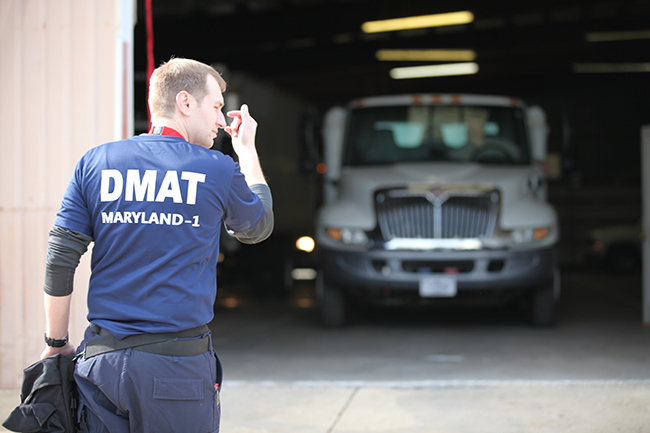
DMAT personnel directs truck pulling out of a garage.

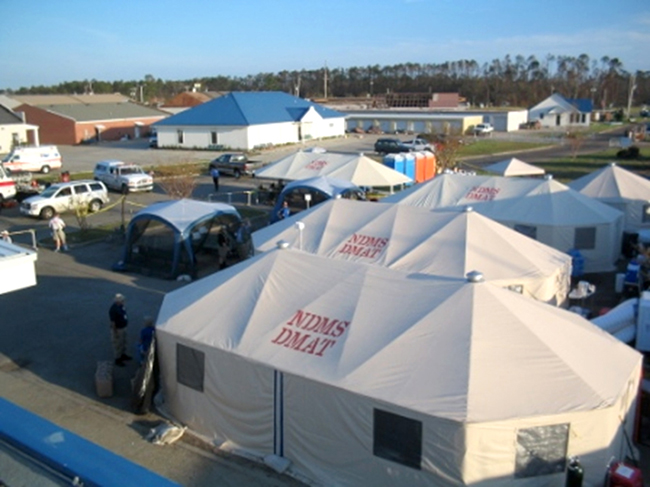
First, NDMS notifies team members that they have been activated. NDMS then arranges for transportation for the teams and meets them at the disaster site with medical equipment and supplies, mobile "field hospital" style tents, and food and water. Teams need to be self-sustaining for 72 hours, since restocking a team can be challenging in the days following a disaster.

Conditions at the disaster site can be very austere. Hospitals, hotels and restaurants may be destroyed. Power and water may be offline in the community. NDMS team members work together through all of these challenges, providing the best possible care in a fast-paced environment.

NDMS DMAT tents.

The details of a deployment vary widely, depending on the nature of the mission, the type of disaster, and the needs of the community. States often will ask ASPR to station NDMS teams in medical tents outside hospitals to help that hospital when emergency care surges after a disaster. They are often deployed with a federal medical station, providing shelter and temporary medical care for people with special medical needs after a disaster.

NDMS works with a network of hospitals across the US that have agreed to accept patients from hospitals in disaster areas requiring patient evacuation. NDMS teams may help triage and prepare patients for transport.

Standing Ready to Respond

NDMS supports a number of National Special Security Events (NSSEs), such as Presidential Inaugurations and the recent Papal visit. NSSEs are designated by the President or the Secretary of Homeland Security as events that are of national significance. ASPR coordinates and co-leads the planning and execution for public health and medical surge for NSSEs. NDMS teams often play an important role in that plan and they stand ready to serve in case of a disaster or emergency at some of our nation's largest and most important events.

NDMS teams may provide health and medical support during NSSEs. Since many NSSEs also are supported by police officers – and their dogs or even horses – NDMS may provide veterinary support as well.

Turning Down a Deployment

Sometimes, the opportunity to deploy conflicts with the personal or professional life of the team members. If this occurs, team members are afforded the opportunity to decline the deployment.

NDMS Seal

Pediatric Disaster Care Centers of Excellence: Funding Opportunity Announcement

Pediatric Disaster Care Centers of Excellence: Funding Opportunity Announcement

Children represent 25 percent of the U.S. population and face specialized medical issues due to their unique developmental and physiologic characteristics. When disaster strikes, minimizing the impacts of children's exposure to infectious diseases, trauma, and other hazards is a challenge for healthcare facilities and stresses the ability of the healthcare system as a whole to respond. Pediatric care requires specialized equipment, supplies, and pharmaceuticals that may not be readily available in an emergency.

While pediatric hospitals provide excellent care for children on a day-to-day basis, a national system is needed that is able to manage the overwhelming and unique medical needs of children after disasters that goes beyond the highly capable system of care available on a daily basis.

On June 28, 2019, ASPR issued the Pediatric Disaster Care Centers of Excellence Funding Opportunity Announcement (FOA) to support the creation of up to two Pediatric Disaster Care Centers of Excellence (COE) that will serve as pilot sites.

During a disaster or emergency, healthcare delivery capacity and capabilities can become compromised. These pilot projects are intended to define the delivery of pediatric clinical care when existing systems are stressed or overwhelmed by enhancing rapid sharing of expertise and assets throughout the state or region. Under this pilot project, recipients will ensure that a well-trained cohort of highly specialized pediatric clinical care providers are available for onsite care and remote consultation. Recipients must ensure that the needs of all pediatric patient populations, including children with special health care needs, and their parents and caregivers are considered and integrated.

This FOA funds demonstration projects to help identify issues, develop best practices, and demonstrate the potential effectiveness and viability of this concept. COEs will be expected to develop and/or improve their capability and capacity to provide highly specialized care to pediatric patients within and outside their own region through the pursuit of the objectives of this announcement. Recipients should have existing pediatric preparedness capabilities and the capacity to manage pediatric patients within their own state and within a self-defined multi-state region during a disaster.

To learn more, see the full-text version of the Pediatric Disaster Care Centers of Excellence Funding Opportunity Announcement and the Frequently Asked Questions.

Pre-Application Teleconference

On July 23, 2019 from 1:00 p.m. - 2:00 p.m. Eastern Time, ASPR hosted a pre-application teleconference for participants to ask questions about the Pediatric Disaster Care Centers of Excellence Funding Opportunity Announcement and application process.

University Hospitals Rainbow Babies and Children’s Hospital

University Hospitals Rainbow Babies and Children’s Hospital

Pediatric Disaster Care Centers of Excellence Cooperative Agreement


This cooperative agreement establishes the Eastern Great Lakes Pediatric Consortium for Disaster Response (EGLPCDR) as a Center of Excellence (COE). University Hospitals (UH) Rainbow Babies and Children's Hospital is leading the consortium, along with five children's hospitals within the states of Michigan and Ohio, to provide expertise with an integrated leadership role within their existing regional emergency preparedness systems. 

This consortium will bring together private and public entities, including Regional Healthcare Coalitions (RHCs), emergency medical services (EMS), EMS for Children (EMSC), public health and emergency managers, to provide a multi-pronged approach to address gaps in the disaster cycle spectrum of mitigation, preparedness, response and recovery for nearly 7 million children. 
Each entity in EGLPCDR provides unique local and state level expertise, including telemedicine, evidence based clinical guidelines, simulation education, drill scenario expertise, and special care units. These entities will have integrated leadership roles within their RHCs, which include eight coalitions in Michigan and seven coalitions in Ohio. 

The overall goal of the EGLPCDR is to harness and develop best-practices around disaster preparedness and response to be shared with other children's and non-children's hospitals as well as affiliated entities in the region. 
 

Priorities and Approach

The methods of achieving this objective will focus on three efforts: individual hospital preparedness, regional capacity expansion for pediatric care, and strategic alignment of regional healthcare systems integrated state-level situational awareness tools. 

1. Individual hospital preparedness: For each of the children's hospitals, a capability assessment of specialized bed capacity will be done and non-children's hospital pediatric capacity has been determined. A tiered system for non-children's hospitals has been developed for pediatric surge response to expand pediatric capability. Education will further expand pediatric capability and incorporate best practices around simulation, telemedicine, on-line and hands on training sessions in conjunction with national resources (custom regional tailoring) from the disaster domain on the EMS for Children Innovation and Improvement Center (EIIC) website. The EIIC has developed and trained providers, hospitals, and other stakeholders across the EMSC continuum on disaster preparedness and recovery.

2. Regional pediatric capacity expansion will be accomplished through the implementation of the pediatric annexes. Innovative programs such as telemedicine, just-in-time training systems and regional pediatric strike teams will be added to the repertoire of resources to expand capability and capacity. COE subject matter experts (SMEs) will enhance current regional exercises to ensure that pediatric-specific metrics are included to inform state level situational awareness. 

3. Strategic alignment of systems and programs, including model integration of state/regional hospital bed status and patient tracking systems specific to pediatrics, will be completed as part of this project. The COE will conduct a review of policies and rules to identify barriers and enablers for mutual aid in disasters within the region.

Existing Collaborations

The co-investigators and personnel have collaborated on previous work in pediatric disaster preparedness and activities of EMSC to improve care for children and families in disasters. Also, the individual SMEs have a history of working with state partners to improve disaster care for children within their respective states; both states and respective SMEs were recipients of American Academy of Pediatrics (AAP)/Center for Disease Control and Prevention grants and conducted virtual disaster exercises statewide. The EIIC, which has matrixed program management with the AAP, the National Association of State EMS Officials, the American College of Emergency Physicians, and the Emergency Nurses Association has assets for dissemination and quality improvement that have been a resource for disaster preparedness and recovery, trauma, prehospital systems, hospitals, healthcare providers and the emergency care space to improve processes and outcomes in the care of children.


Regents of the University of California, San Francisco

Regents of the University of California, San Francisco

Pediatric Disaster Care Centers of Excellence Cooperative Agreement

Under the Pediatric Disaster Care Centers of Excellence Cooperative Agreement, the University of California, San Francisco (UCSF) Health System and UCSF Benioff Children's Hospitals, are leading the Western Region Alliance for Pediatric Emergency Management (WRAPEM). WRAPEM is an alliance of health care providers, pediatric medical centers, subject matter experts and government agencies throughout California, Oregon, Nevada, Arizona and Washington, representing the most extensive collection of pediatric preparedness and response experts ever assembled. WRAPEM serves a region that includes nearly 13 million children. 
WRAPEM includes the majority of the western states' pediatric medical centers, disaster coalitions, large community health care systems, representatives from state and local agencies, and coalition partners. The group includes subject matter experts with backgrounds in chemical biological, radiological, and nuclear (CBRN) preparedness, trauma, burns, disaster mental health, telemedicine, education, EMS, obstetrics, ethics, and law. 

The goal of WRAPEM is to develop a coordinated, collaborative and sustainable regional pediatric disaster planning and response capability that effectively matches resources to needs during large scale pediatric mass casualty events. WRAPEM will be governed by a leadership board and operational staff that represent all of the areas served and incorporates institutional expertise from medical centers, subject matter experts, and government agencies.

Priorities and Approach

WRAPEM will conduct a comprehensive review of all available resources, which will then be catalogued into a resource guide that aligns existing capabilities with regional needs. This resource guide will define the core elements of regional capabilities including:

  • available assets;

  • supply chains;

  • existing surge and evacuation plans;

  • outcomes and lessons learned from exercises and real time events;

  • current legal and ethical policies;

  • current deployable staff equipment and assets;

  • telemedicine capabilities;

  • patient tracking and reunification;

  • communications; and

  • pediatric disaster mental health considerations.

An evaluation of existing training and educational, (including web-based) communications tools, situational awareness and pediatric readiness metrics and regional readiness assessment tools will be completed. Training will be developed to enhance the capacity and capabilities for treating pediatric patients involved in mass casualty events involving CBRN agents; penetrating and other trauma; burns; and epidemic infectious diseases. A publicly accessible website and telecommunications platform will be the core repository for all of these efforts.

WRAPEM will conduct a formal regional gap analysis to inform the ability to establish a comprehensive and integrated response model that addresses CBRN, trauma, burns and other natural and technological disasters that potentially have a disproportionately high impact on children.

Additionally, WRAPEM will focus on several key projects with deliverable products and measurable impact. These include:

  • developing a published guide for accessing regional pediatric disaster response expertise, along with an operational coordination center integrating established state and federal responders;

  • compiling regional resource material that align interstate pediatric best practice and policy;

  • developing training modules with a pediatric specific focus for all event types;

  • establishing telemedicine interconnectedness across the region;

  • implementing regular pediatric focused exercises with broad regional participation;

  • developing patient tracking, reunification and information-sharing practices that address interstate operational complexity; and

  • formulating a regional Pediatric Disaster Mental Health plan.

These efforts will be closely coordinated with ASPR and the other selected Center of Excellence. The accomplishments will be used to define a pediatric regional health care response system model that can be further enhanced and integrated with overall emergency operation plans to deliver the very best outcomes for children and their families.

Claims Submission

Claims Submission

NDMS Definitive Care Reimbursement Program

Claim Formats

When possible, providers should submit claims electronically via a claims clearinghouse service to payer code NDMSJ29 (HHS NATIONAL DISASTER MEDICAL SYSTEM-J-29). For all electronic claims received, an electronic remittance advice will be returned which will make payment reconciliation more efficient for the provider.

If needed or preferred, the program will continue to accept hard copy claims as well. Hard-copy claims must be submitted to J29 using industry standard pre-printed claim forms:

Secondary claims should be mailed to the program in hard-copy format along with a copy of the remittance advice or explanation of benefits document received from the primary payer.

Mail hard-copy claims to J29 at 1111 Benfield Blvd, STE 114 Millersville, MD 21108. 

Claim Submission Quick Guide

The NDMS Definitive Care Reimbursement Program has compiled a NDMS Claims Submission Quick Guide to assist claimants with the submission process. The guide provides benefit examples that are claim eligible and a claim submission checklist to follow when submitting a claim. 

Claim Submission Quick Deadline 

The NDMS Definitive Reimbursement Program is currently not activated and is not accepting any claims. 

Copies of Medical Records for Inpatients

Please note that the NDMS may require copies of medical records for all patients who are admitted as inpatients by facilities to support their follow up utilization and efficacy studies.

Appeals

In the event that a provider would like to appeal a claim adjudication decision or payment amount, the NDMS Definitive Care Appeal form should be completed and submitted with all supporting documentation within 45 days of receipt of a remittance advice or claim denial notice from the program. Mail appeals to:

ATTN: NDMS Appeals J29 
1111 Benfield Blvd, STE 114 
Millersville, MD 21108 
or fax them to: 202.892.7200, or send via encrypted email only to: ndms@j29inc.com

Appeals Submission Deadline 

The deadline for filing an appeal is 45 days after receipt of the Explanation of Benefits from NDMS. 

Reimbursement Rates

Reimbursement Rates

NDMS Definitive Care Reimbursement Program

Reimbursement Rates for Facilities

For facilities actively participating in the Medicare program, subject to the Coordination of Benefits Guidelines, the Program will reimburse the facility at the lesser of:

  1. Billed charges for covered services; or

  2. 125% of the amount that the facility would be paid under Medicare Part A or Medicare Part B (excluding pass-through payment components) if the facility has executed a Memorandum of Agreement (MOA) for Definitive Medical Care with NDMS; or

  3. 100% of the amount that the facility would be paid under Medicare Part A or Medicare Part B (excluding pass-through payment components) if the facility chooses not to execute a MOA with NDMS; or

  4. 100% of the amount that the facility would be paid under Medicaid if the facility does not currently participate in the Medicare program or if the qualifying service is not covered under Medicare Part A or Part B but is covered under Medicaid.

Reimbursement Rates for Practitioners

For practitioners actively participating in the Medicare program, subject to the Coordination of Benefits Guidelines, the Program will reimburse the practitioner at the lesser of:

  1. Billed charges for covered services; or

  2. 100% of the amount that the practitioner would be paid under Medicare Part B; or

  3. 100% of the amount that the practitioner would be paid under Medicaid if the practitioner does not currently participate in the Medicare program or if the qualifying service is not covered under Medicare Part B but is covered under Medicaid.

For more detailed information on specific reimbursement rate questions, please contact us at DefinitiveCare@hhs.gov.

Subscribe to USWDS Height Card Large (240px)