





PHEMCE Mission, Vision, and Function
The PHEMCE is an interagency partnership of federal medical countermeasure experts who collaborate across sectors to protect the U.S. population during public health emergencies that require the availability and timely provision of effective medical countermeasures. The PHEMCE exists to provide a cohesive federal process for medical countermeasure development, acquisition, distribution, and dispensing, bridging gaps in the country's medical countermeasure portfolio.
MCMs include both pharmaceutical interventions (e.g., vaccines, antimicrobials, antidotes, antitoxins, or other therapies such as those that may target the host) and nonpharmaceutical interventions (e.g., medical devices including diagnostics, life support products, personal protective equipment, decontamination systems, and clinical decision-making support tools), as well as other needed medical products that may be used to detect or assess, prevent, mitigate, or treat the adverse health effects of a public health emergency caused by a naturally occurring, accidental, or deliberate threat.
The PHEMCE, at its core, is responsible for 1) identifying what capabilities are needed to protect the U.S. population, 2) developing strategies to address gaps in our capabilities, and 3) making recommendations to the HHS Secretary to improve access to medical products during public health emergencies and disasters.

Vision
A coordinated medical countermeasure (MCM) enterprise that enables the nation to prepare for and respond to national health security threats

Mission
To guide the USG MCM portfolio and enhance the nation's capabilities to prepare for and respond to national health security threats
Co-chaired by the Administrator and Assistant Secretary for Preparedness and Response (ASPR) and the Director of the Office of Pandemic Preparedness and Response Policy (OPPR), PHEMCE membership includes the Director of the Centers for Disease Control and Prevention, the Director of the National Institutes of Health, the Commissioner of the Food and Drug Administration, the Secretary of Defense, the Secretary of Homeland Security, the Secretary of Agriculture, the Secretary of Veterans Affairs, and the Director of National Intelligence.
The PHEMCE meets quarterly to discuss key issues and make recommendations. Additionally, subject matter experts and technical teams from across the member agencies meet routinely to bring together information. Information may touch on analyzing the current threats; early and advanced research and development, including enabling technologies; monitoring and surveillance; manufacturing; supply chains; regulatory science; procurement and stockpiling; and the deployment, distribution, dispensing, and administration of medical countermeasures.
The PHEMCE does not recreate each of these functions but rather builds on the existing infrastructure for these activities to inform recommendations for the Secretary of HHS.
This partnership informs the plans and actions that ensure the right balance of medical countermeasures and improves availability and use of those medical countermeasures during disasters and emergencies. Improving the capabilities also enhances the nation's ability to nimbly respond to unknown and unforeseen threats. 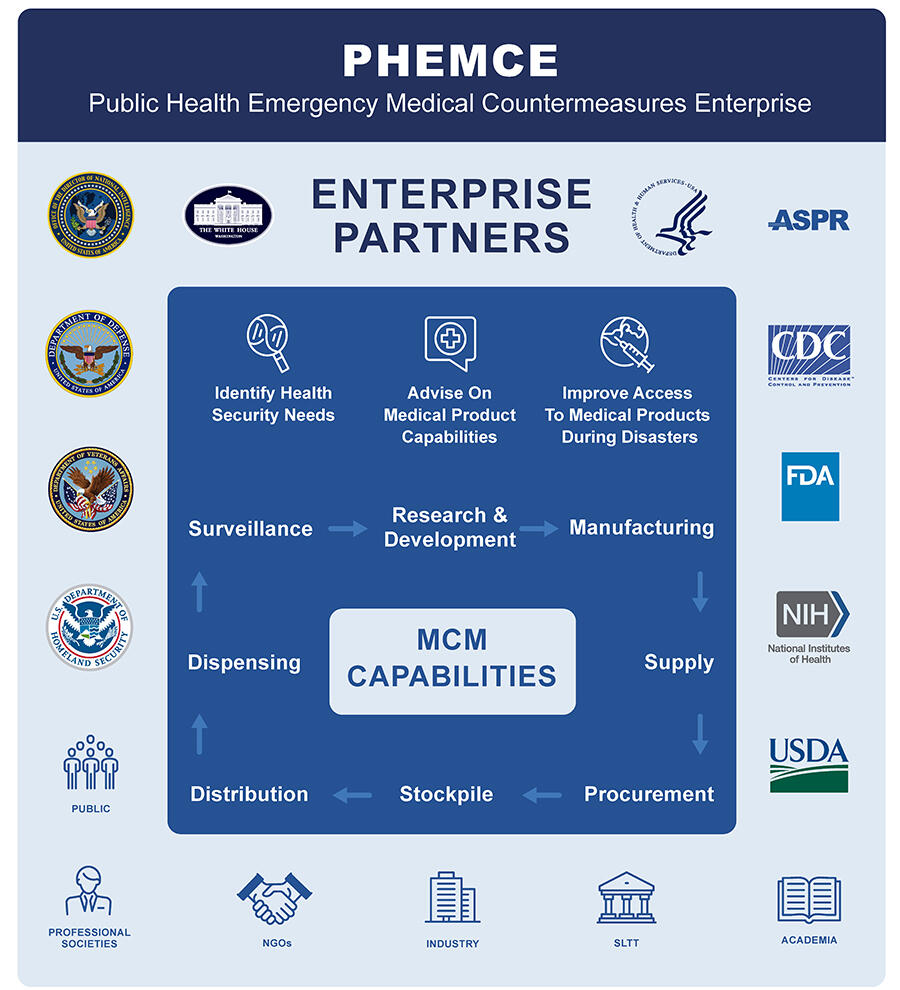
The PHEMCE was established by the Department of Health and Human Services in 2006 and codified by Congress in 2019 to advance the country's medical countermeasure preparedness against chemical, biological, radiological, nuclear threats, and emerging infectious diseases (EID).