





Chapter 2: The Healthcare Coalition as a Response Organization: System Description
2.1 The Healthcare Coalition Overview
The Healthcare Coalition is useful for all phases of Comprehensive Emergency Management, but its primary mission should be to support healthcare organizations during emergency response and recovery. An element of this mission is promoting integration of Coalition member organizations into the broader community response.
In emergency management, the response organization is typically described in an Emergency Operations Plan (EOP). The comprehensive EOP incorporates a System Description, which presents the elements of the response organization (including an organizational chart) and how they are related to each other. This chapter presents a System Description for the Healthcare Coalition response organization based on MAC System concepts summarized by NIMS (see Sections 1.4 and 1.5).
The specific objectives for a Healthcare Coalition during emergency response and recovery may vary from one Coalition to another. It is up to the healthcare system planners to establish what the Coalition should achieve during response. Therefore, response objectives may be simple or complex depending upon the individual Coalition. Sample response objectives for a robust Healthcare Coalition include:
Facilitate information sharing among participating healthcare organizations (Tier 1) and with jurisdictional authorities (Tier 3) to promote common situational awareness.[22]
Facilitate resource support by expediting the mutual aid process or other resource sharing arrangements among Coalition members, and supporting the request and receipt of assistance from local, State, and Federal authorities.
Facilitate the coordination of incident response actions for the participating healthcare organizations so incident objectives, strategy, and tactics are consistent for the healthcare response.
Facilitate the interface between the Healthcare Coalition and relevant jurisdictional authorities (Tier 3) to establish effective support for healthcare system resiliency and medical surge.
Coalition Participants
The Healthcare Coalition may include the full range of healthcare assets that provide "point of service" medical care and other medically related services during a mass casualty and/or mass effect incident. Depending on how a particular Healthcare Coalition is constructed, this may include hospitals, community health centers, integrated healthcare systems, private physician offices, outpatient clinics, dialysis and other specialty treatment centers, and long-term care facilities (nursing homes, other skilled nursing facilities), and home care/hospice.
Coalition Activities
During emergency response, the Coalition's response organization conducts a range of activities to achieve its stated objectives. Some examples of possible activities for the Coalition's response organization are provided below.
Provide notification to member organizations that an actual or potential incident is developing. This allows for very rapid response (i.e., within minutes) on a 24/7 basis. The notification threshold is set by Coalition member organizations such that if one member knows an incident is happening, all learn of it rapidly.
Provide a mechanism to rapidly disseminate information from Incident Command and other authorities to Coalition member organizations so that they can effectively and safely participate in emergency response.
Rapidly disseminate information from Coalition member organizations to Incident Command and other authorities, at their request.
Convene (often virtually) specific personnel (senior executives, technical specialists, etc.) from Coalition member organizations at the request of incident command authorities to discuss strategic issues or make policy recommendations related to the healthcare response.
Help Coalition member organizations obtain incident-related information that is not otherwise readily available. The Coalition response organization can serve as the official representative of member organizations to seek incident details that are important to the healthcare response.
Disseminate resource needs to member organizations and help match organizations that request mutual aid or other assistance with organizations that can provide the needed assistance.
Facilitate the coordination of response actions among member organizations if this is requested by the Coalition's responding members and/or by jurisdictional authorities.
Coalition Authorities
The Healthcare Coalition's authority to operate is based on the voluntary endorsement and support of its member organizations and relevant Jurisdictional Agencies in its geographic area. It is primarily responsive to its member organizations' concerns.
The Healthcare Coalition's member organizations are responsible to the Jurisdictional Agency(s) in the geographic area in which each operates. Thus, if the Healthcare Coalition spans the borders of multiple jurisdictions, the Coalition's response organization must coordinate closely with all relevant Jurisdictional Agencies. The Coalition's actions supplement the authority of the local and State governments that are responsible for the geographic area covered by the Healthcare Coalition. In some situations, the Jurisdictional Agency may issue a "Delegation of Authority" that authorizes the Coalition on behalf of the jurisdiction to address medical and public health related response matters.
Because of these considerations, the emergency response and recovery authority of the Healthcare Coalition may be limited, but this does not obviate the importance of the Coalition's mission.
The design and function of the Healthcare Coalition response organization is based on the following assumptions:
Participating organizations maintain their respective decision-making sovereignty during incident response, except in unusual circumstances that warrant the implementation of local or state health authorities (e.g., enactment of isolation or quarantine).
Participating organizations determine individually how they will respond to an incident and whether they will activate any emergency response procedures. The Coalition does not supplant this responsibility.
The Healthcare Coalition response organization may convene (often virtually) representatives from its member organizations to discuss response issues. Decisions made by the Coalition during incident response are made on a consensus basis or are recommendations only.
Healthcare Coalition partners will work together for a common good despite day-to-day competition, especially if a fair platform with transparent decision-making is provided for this functional relationship.
Support from the administrative leadership of each participating organization can be achieved with proper attention to the design and function of the Coalition.
The use of NIMS-consistent concepts and procedures will promote integration with public sector response efforts; NIMS consistency is also required to be eligible for Federal funding.
During emergency response, personnel staffing the Healthcare Coalition Response Team (HCRT) are still employed by their "home" organization and often are responsible for some element of their home organization's response. Therefore, HCRT staffing must be as lean and efficient as possible. In some Coalitions, this may mean enabling HCRT staff to conduct response tasks remotely rather than from one centralized location. In addition, personnel from the most affected organizations should be able to rapidly "hand off" Coalition duties to other qualified personnel.
2.2 The Healthcare Coalition Baseline Operations
For the Healthcare Coalition to be immediately available to conduct response actions in a no-notice, sudden onset emergency, two functions must be continuously operational even during times of non-response: 1) the ability to rapidly receive information and notify Coalition members of an emergency,[23] and 2) a decision-making process to determine whether additional Healthcare Coalition actions are necessary.
The manner in which these functions are addressed may vary from one Coalition to another. What does not vary is the need for a continuous baseline capability to conduct these two functions so they are operational at the outset of any incident. The authors of this handbook propose two entities to help the Coalition maintain readiness for immediate response: Healthcare Coalition Notification Center and Healthcare Coalition Duty Officer. These functions constitute the baseline operations of the Healthcare Coalition and may be conducted at minimal expense and burden to the Coalition.
The Healthcare Coalition Notification Center provides notifications (both initial and ongoing) to Coalition member organizations regarding an emergency. It may also notify Jurisdictional Agencies (Tier 3) about a developing situation within a healthcare organization. The information that prompts notifications may originate within the healthcare community, public sector authorities, or other sources (e.g., the media). The Notification Center's roles and responsibilities include:
To receive information that a situation is occurring that might affect Coalition member organizations (Tier 1) and convey emergency notification to members and relevant Jurisdictional Agencies (Tier 3)
To receive specific messages from Jurisdictional Agencies (Tier 3) for transmission to healthcare organizations (e.g., notification of a large transportation incident)
To receive messages from a Coalition member organization for transmission to other members or to Jurisdictional Agencies (e.g., power outage at a hospital)
To maintain connectivity with relevant organizations, including other Healthcare Coalitions in nearby jurisdictions
To contact the Healthcare Coalition Duty Officer, as appropriate, to clarify message content and message urgency, or to determine the most appropriate method for sending notifications.
To accomplish these roles, the following requirements are proposed for the Healthcare Coalition Notification Center:
The Notification Center must be staffed 24/7 by trained and qualified personnel. The position that conducts the Center's actions is designated in this text as the Coalition Notification Center Technician, but some other title may be substituted.[24]
The capability to receive and send information via telephone, radio, e-mail, facsimile (fax), and other redundant messaging modalities.
Ability to receive television and commercial radio broadcasts.
Rapid connectivity with jurisdictional authorities (Public Health, EMS, Emergency Management, Law Enforcement, etc.) as well as Coalition member organizations.
Ability to conduct large capacity teleconferencing.
Redundant communications with primary and emergency backup power.
The authors use the word "center" to emphasize that this should be a physical location with the ability to perform these critical functions. At the same time, the Healthcare Coalition Notification Center typically should not be an expensive, stand-alone facility dedicated only to this purpose. To promote cost-effectiveness, the Healthcare Coalition Notification Center may best be collocated at an already continuously staffed facility that can meet the information and communications requirements noted above. For example, a private ambulance dispatch center has been successfully used for this purpose in several Coalitions. Healthcare facilities that operate as the regional hospital resource have also performed this function. Alternatively, Coalitions may use an established public sector resource, such as a municipal communications center, for this function; however, the Coalition must be able to access these systems when needed and not just when the public sector has declared an emergency.
An alternate Coalition Notification Center should be identified so these functions can be maintained if the primary center is affected by a hazard impact or if the center's other responsibilities during a disaster prevent it from performing Coalition activities. Backup centers must be able to perform the same functions as the primary center. To maintain this backup capability, the alternate site may intermittently assume the role of the primary Notification Center during baseline operations.
Healthcare Coalition Notification Center Technician
This position operates the Coalition Notification Center and monitors baseline information 24/7 for any health-related anomalies that might signal the need for a response by the Healthcare Coalition. The Coalition may establish protocols to help the technician identify incident parameters that require immediate notification to Coalition member organizations and the Coalition's Duty Officer. When initial incident information does not clearly indicate the need for a notification, the technician contacts the Coalition's Duty Officer (see below) to further discuss whether a notification is required. These procedures are described in greater detail in Chapter 3.
Personnel serving as the Coalition Notification Center Technician should have the following qualifications:
Expert ability to operate the communication equipment for Coalition notification activities
Operational level of understanding about the Healthcare Coalition's purpose and its emergency response mechanisms
Operational knowledge and skill for developing and transmitting straightforward notification messages using Coalition templates (see Section 3.3).
The technician position must be staffed 24/7; however, it may be performed by a trained and qualified professional whose primary job is private sector EMS dispatch, poison center operations, or other position that is always immediately available. It is important to identify a backup for this position so notifications to the Coalition can be maintained despite a surge in other duties.
This on-call position must be available for initial consultation to the Notification Center Technician, to Coalition members, and to jurisdictional authorities (Tier 3) as the representative of the Healthcare Coalition. The Duty Officer serves as the Coalition's liaison to Jurisdictional Agencies during the initial stages of an incident and may contact Jurisdictional Agencies to obtain relevant information about an incident to share with the Coalition member organizations.
Potential responsibilities of the Duty Officer include:
Provide consultation to the Notification Center Technician (upon the technician's request) regarding whether a potential or actual situation warrants a notification to Coalition members. The Duty Officer also provides advice on the content or urgency of the notifications being disseminated.
Obtain incident information (pre-HCRT activation) that is relevant to healthcare organizations and disseminate it to the Coalition member organizations.
Determine whether to activate the HCRT and the initial staffing plan for an activated HCRT.
Upon activation of the HCRT, the Duty Officer may become the HCRT Leader or assume another position and brief personnel as they are assigned to the HCRT.
Personnel staffing the Healthcare Coalition Duty Officer position should have the following qualifications:
Expert knowledge of their home organization's emergency management program and EOP.
Operational knowledge of the Healthcare Coalition's EOP and methods for interacting with relevant jurisdictional authorities.
An operational understanding of NIMS and MAC System operations (NIMS compliance requires successful completion of IS 100.a, 200.a, and 700.a web-based courses through FEMA's Emergency Management Institute). Additional courses focused on MAC System concepts are also recommended, such as IS 701.[25]
Endorsement for this role from their home organization.
Ability to take calls for a defined period of time (e.g., a week) and respond to all potentially emergent communications requests.
Ability to carry a reliable, mobile contact method (cellular telephone, two-way pager, text messaging device) at all times while staffing the Duty Officer position.[26]
2.3 The Healthcare Coalition Response Team
The Healthcare Coalition Response Team (HCRT) conducts the response activities for the Coalition and provides a more robust operational capability than the Duty Officer and Notification Center Technician functions alone. The HCRT accomplishes the Coalition's response objectives (see Section 2.1.2) during an emergency.
The HCRT is composed of personnel from Coalition member organizations who perform the key response functions of the Coalition, and an organizational liaison from each Coalition member to directly represent the healthcare organization. It is important to recognize that the staffing arrangement for the HCRT will vary based on the complexity of the Coalition and the needs of a specific incident. In many situations, the HCRT functions can be performed by a minimal number of staff.
The scope of response activities performed by the HCRT will vary from one Coalition to another depending on the response objectives established during Coalition development (see Chapters 5 and 6). The HCRT's activities do not inhibit any individual organization's response and recovery actions. The responding organizations conduct whatever actions they need to during an emergency, but they share information and develop common efforts where indicated and advantageous to the Coalition members. Similarly, the Coalition does not supplant the local public health agency's response activities.
NIMS does not specify any one structure for managing MAC System activities. Emergency Management Institute (FEMA) training (IS 701) presents several models that have been used by government agencies for establishing and managing EOCs. These models may be examined for relevance in managing the HCRT.[27]
The authors of this handbook recommend an ICS-based model for managing the HCRT because this approach has been validated in managing many types of complex activities under emergency conditions. It is important to understand that using ICS in a MAC System does not mean that the EOC-like function (i.e., the HCRT) is managing the incident itself. The HCRT supports the incident managers, whether the incident is based at the jurisdictional level (Tier 3) or a member organization (Tier 1). Using an ICS-based structure also ensures consistency with NIMS and with the organizing strategy used by most healthcare organizations for their own EOPs. The Hospital Incident Command System (HICS), which has been adopted by many healthcare organizations for incident response, is based on ICS.[28]
While the ICS-based model employs the traditional IMT structure (Figure 2-2), the responsibilities and processes addressed in the HCRT may be somewhat simplified. For example, because the Administration/ Finance Section may have minimal responsibility in a Healthcare Coalition response, it may be subsumed as a supporting function within the Planning or Logistics Sections (this is consistent with NIMS guidance).
Figure 2-2. Basic configuration for the HCRT
Figure 2-2: An HCRT Leader, who will report to the senior policy group, oversees the HCRT Operations Section Chief, HCRT Logistics Chief, and HCRT Planning Section Chief. The HCRT Logistics Section Chief works with a communication unit and the whole system will receive input from the notification center. Healthcare Organization Liaisons are crucial for providing feedback and information.
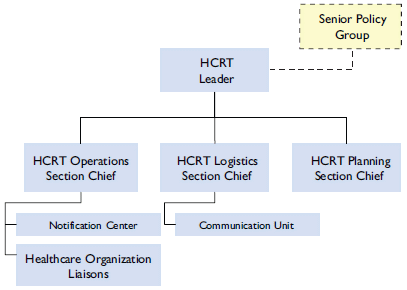
As with traditional ICS descriptions, only the HCRT positions that are required to respond to an incident are activated. The size and complexity of the HCRT may vary significantly in each locale. In fact, it is expected that most Healthcare Coalitions will respond to a majority of incidents with one to three individuals conducting all HCRT functions. Conversely, complex Coalitions or those responding to very complex incidents could require a more robust response organization. The key functions of the HCRT are outlined below for consideration.
Leader (equivalent to Command in traditional ICS)
This function oversees all HCRT activities. Because there is no inherent "command" authority within the Healthcare Coalition and the Coalition does not directly manage the incident, the term "Leader" is more appropriate to describe this function within the HCRT. Since this function is responsible for all HCRT activities, it is the one function that must always be staffed for any incident.
Operations Section
Depending on a Coalition's response objectives, the Operations Section of the HCRT would be responsible for several activities. If response activities are particularly complex for an incident, this Section may be subdivided into branches, divisions, or groups, but this usually will not be necessary. Factors that may influence the branch construct include the number and size of the organizations within the Coalition, and the complexity of the data and information being processed.[29] Example activities for the HCRT Operations Section include:
Information management: Provide an information "clearinghouse" to promote enhanced situational awareness. The term clearinghouse is used to emphasize that information is collected, aggregated, and transmitted to healthcare organizations with only transparent processing of the data. All member organizations are treated equally and provided with a common operating picture of the incident. This promotes consistency in decision-making across the organizations.
Resource coordination and support: Facilitate the ability of member organizations to obtain resource support under the time urgency, uncertainty, and logistical constraints of emergency response. It does not preclude the use of day-to-day resource acquisition methods, nor does it supplant the importance of developing resource acquisition and management methods at each healthcare organization (Tier 1). Rather, it provides a platform for disseminating resource requests from impacted organizations. In addition, the HCRT may facilitate communications between requesting organizations and those willing to provide resource support.
Response coordination: Promote comprehensive and consistent incident action planning by Coalition member organizations through the sharing of response objectives, strategy, and major tactics. Task forces may be established to address unusual response issues, such as urgently needed, consensus-based diagnostic or treatment guidelines, patient transfer protocols, tracking of evaluated patients, or other actions.
Community response integration: Facilitate the integration of the healthcare response into the general community response by promoting exchange of information between member organizations and responding Jurisdictional Agencies (Tier 3).
During response, the HCRT Operations Section interfaces with the member organizations through their designated HCRT Organizational Liaison within the member organization's IMT.[30] This liaison position must be established to ensure efficient Coalition response activities. Depending upon how the Coalition is constructed, the Organizational Liaison could be responsible for:
Receiving information from the HCRT and acknowledging receipt of the information
Transmitting information from the HCRT to decision makers within the organization (e.g., the organization's IMT)
Supervising the response to requests for information or resource assistance that comes through the HCRT
Participating in meetings or teleconferences convened by the HCRT to bring together healthcare organizations.
Support Functions
Consistent with the ICS model, the HCRT may wish to develop the following Sections to support its response operations. Even if a Coalition defines specific positions for HCRT response functions, it is important to recognize that the positions are only staffed as needed. Position descriptions should be developed, and training and exercises conducted, to develop the knowledge, skills, and abilities for staff.
Planning Section: Depending upon the complexity of the Healthcare Coalition, the Planning Section could perform a number of response activities focused on aggregating incoming data and formatting information reports to return to member organizations. This collated information is usually conveyed to jurisdictional authorities (Tier 3). The following responsibilities for the Planning Section are presented for consideration:
Aggregate, analyze, format, and document relevant incident information in standard reports. For example, the Planning Section may document incident details or the resource status of member organizations, such as available patient beds.[31] The data should be captured in a standardized format and provided to all Coalition member organizations and relevant Jurisdictional Agency(s) (Tier 3).
Facilitate internal HCRT meetings. The Planning Section can facilitate meetings or teleconferences for internal HCRT planning. For meetings involving Coalition member organizations (Tier 1), it may be more appropriate for the HCRT Operations Section to facilitate, since these discussions support achievement of the HCRT response objectives. The purpose, format, and ground rules for each type of meeting should be pre-determined.
Oversee action planning for the HCRT: In robust Coalitions, the HCRT may wish to conduct formal action planning when indicated by incident circumstances. Action planning is well accepted in MAC Systems even though these systems do not command an incident. The Planning Section could be tasked with assembling and completing the action plan for the Healthcare Coalition. If created, the HCRT action plan should be shared with Coalition member organizations and jurisdictional authorities. The plan itself may be shared or it may be discussed in an operations briefing (often conducted virtually) with relevant organizations.
Logistics Section: Per ICS principles, this Section provides logistical support to the HCRT and is distinguished from support that is provided to Coalition members, which is a function of the HCRT Operations Section. Because many of the HCRT's activities during emergency response and recovery can be conducted virtually, the key logistical issue will be supporting the information and communications technology that is used by the HCRT and its member organizations. For example, the Logistics Section may address a Coalition member organization's difficulty accessing web-based programs or troubleshoot issues with radio equipment. Other types of support that may be performed by the Logistics Section include:
Staff scheduling for HCRT positions during prolonged incidents
Resource support to the HCRT and the Coalition's Notification Center, including facilities, transportation, and other resources
Services support, such as food and drinks, communications and information technology support, sleeping quarters, etc.
Administration/Finance Section: Per ICS, this Section focuses on administrative and finance support to the HCRT and is staffed only as needed. This becomes important if there is an expectation for reimbursement for some of the distributed HCRT activities, such as reimbursing member organizations for employee time devoted to HCRT positions staffed during an emergency. Other cost tracking may include any expenses assumed by an organization that provides a physical location for HCRT operations or the Coalition Notification Center. This Section notes when spending may be approaching limits set by the Coalition Senior Policy Group and brings this to the attention of the HCRT Leader. This function is expected to be rarely staffed as a separate HCRT Section.
In order for the HCRT to function as intended, the following requirements must be met:
Communications and information technology must be available 24/7 for use by the Healthcare Coalition. This may include a messaging system (text and/or voice), a radio system, relatively secure teleconferencing methods, satellite phones, Voice Over Internet Protocol (VoIP), and technology to support web-based interaction between Coalition member organizations and between the Coalition and jurisdictional authorities (Tier 3). A good cost-saving measure is to use technologies established for other purposes (e.g., using a web-based system established for a Jurisdictional Agency). However, it is important that the technology is always available for dedicated use by the HCRT during emergency response.
Personnel must be identified to staff the HCRT during incident response. These individuals will usually be employees of the Coalition's member organizations. Because these organizations may be impacted by a hazard, candidates for the HCRT should be identified from as many organizations as possible and focus should be on streamlining the staffing of the HCRT during emergency response and recovery.
Procedures should be established to maintain HCRT activities despite a hazard impact, with backup resources identified for each essential HCRT function.
Exhibit 2-1 highlights some of these requirements as applied to a Healthcare Coalition in Minnesota.
Exhibit 2-1: Regional Hospital Resource Center (RHRC) in the State of Minnesota
The State of Minnesota has been divided into eight regions, each having developed a response organization that coordinates the efforts of healthcare assets within its respective geographic region. Though the regions align with Public Health and Emergency Medical Services (EMS) regions within the State, they do differ from State Patrol and Homeland Security and Emergency Management (HSEM) regions.
Each Healthcare Coalition spans multiple independent jurisdictions and coordinates response information among its participating healthcare organizations, including hospitals, healthcare systems, and clinics (clinic coordination is less formal at present and variable between regions). This requires direct communications with each individual jurisdiction covered by the Coalition when coordinating healthcare assets during incident response. This important activity ensures a common operating picture for all local authorities.
The Healthcare Coalition that includes Minneapolis is based at Hennepin County Medical Center. Its day-to-day communications center is utilized to coordinate healthcare assets located within this response Coalition. Communications to individual healthcare assets are based on internet, 800 MHz radio, and telephonic communications. A Duty Officer is always available to receive notifications and this contact method is disseminated to public safety agencies. If the Healthcare Coalition response organization is to be activated, the staffing typically involves 3-4 personnel to cover all the functions of the response organization. These personnel are "donated" by individual healthcare organizations and may be supplemented by staffing from the local Medical Reserve Corps (MRC).
The response activities can be conducted from the communications center or in a more distributed fashion (personnel remain at their location of regular employment). In addition, Coalition personnel have the capability to deploy to the Emergency Operations Center (EOC) where they can more directly interface with Public Health, Emergency Management, and EMS. The Coalition has the capability of convening regular teleconferences as required for its participating organizations.
After the Interstate 35W Bridge collapse in Minneapolis on August 1, 2007, the RHRC assisted EMS with organizing patient lists, tracking delayed casualties, and providing Family Support Center staff and support. The RHRC also coordinated with Minnesota Department of Health and other agencies to provide awareness of available healthcare assets.
2.4 The Healthcare Coalition Senior Policy Group
It is important for Coalition developers to consider how executive level input from Coalition members will be incorporated into the HCRT during emergency response. In accordance with NIMS principles, this can be achieved through a MAC Group-like entity, which is named the Healthcare Coalition Senior Policy Group in this handbook. Example objectives for the Senior Policy Group include:
Develop policy-level decisions as indicated by the situation or as requested by the HCRT Leader.
Address major resource commitments that Coalition members may be asked to provide. For example, the Senior Policy Group could convene to approve hospital commitment of beds to support the evacuation of a facility that is not a member of the Healthcare Coalition.
Approve risk reduction strategies and other strategic issues that may arise during emergencies and disasters. For example, the Senior Policy Group could be used to approve a common public statement distributed to the media describing patient safety measures during an infectious outbreak.
Maintain optimal situational awareness for senior executives for sensitive information that may not be available to the HCRT. For example, law enforcement and intelligence authorities may wish to brief senior leaders of healthcare organizations on sensitive security threat details that are not released to the general public.
Monitor the HCRT for strategic effectiveness in its response and recovery roles.
The Senior Policy Group is composed of the Chief Executive Officer, senior administrator, or their designee from each member organization, who has authority to make decisions, commit resources, and accept high-level risk for their organization. In a large Coalition, a process may be established to select representatives for the Senior Policy Group. The jurisdiction's Public Health authority, EMS chief, and/or other Tier 3 authority may be invited to participate in advisory positions.
The Senior Policy Group assembles (often virtually) only as needed during incident response for briefings and to deliberate on strategic and policy-level issues. It may also assemble if concern arises regarding the functional effectiveness of the HCRT.
Senior Policy Group activities during emergency response and recovery generally include participating in briefings given by the HCRT Leader to maintain situational awareness among senior executives. The Senior Policy Group may provide strategic and policy guidance that the HCRT can implement. The Senior Policy Group does not become involved in operational management, tactical decision-making, or other issues addressed by the HCRT unless a strategic or policy imperative arises.
Support requirements for the Senior Policy Group are relatively simple and most will be accomplished through capabilities that support the HCRT. The additional requirements include the following:
Senior Policy Group briefings and meetings should be tightly facilitated to limit time commitments and keep the focus on policy and strategic issues.
Meeting space should be identified for the Senior Policy Group, although most Senior Policy Group meetings will be conducted via teleconference or video conference. Protocols for conducting these meetings should be pre-established and shared with the appropriate participants.
If these meetings are conducted via teleconference or video conference, the information technology and communications system used for Senior Policy Group meetings should ensure that sensitive information may be discussed and protected.
22. Throughout this handbook, emphasis is placed on the need for the Healthcare Coalition to integrate with public sector agencies at the local jurisdictional level (Tier 3). In areas of the country with limited or no local public health capabilities, the Healthcare Coalition may coordinate directly with the relevant State authorities (Tier 4).
23. Some Coalitions may rely on public sector notification systems being activated. These Coalitions are encouraged to develop notification processes and procedures (even if using public sector technology) that are immediately available to the Coalition for incidents that do not reach the level of public sector emergencies (e.g., power outage at a hospital).
24. The Healthcare Coalition should establish training requirements for this position during preparedness activities (see Chapter 6)
25. FEMA Emergency Management Institute, IS 701, NIMS Multiagency Coordination System.
26. Established Healthcare Coalitions usually roster backup Duty Officers in case there is a problem contacting the primary Duty Officer.
27. FEMA Emergency Management Institute, IS 701, NIMS Multiagency Coordination System. Accessed May 7, 2009.
28. State of California Emergency Medical Services Authority, Hospital Incident Command System Guidebook, (August 2006).
29. The organization of Operations Section branches is further discussed in Chapters 3 and 4.
30. Another title, such as Point of Contact or "POC," may be used for this staffed position at each Healthcare Coalition member organization.
31. The actual collection of data and dissemination to individual healthcare organizations (Tier 1) and jurisdictional authorities (Tier 3) is an Operations Section function. The actual collection of data and dissemination to individual healthcare organizations (Tier 1) and jurisdictional authorities (Tier 3) is an Operations Section function.