





Chapter 1: Healthcare Emergency Response and the Need for a Healthcare Coalition
1.1 Mass Casualty and Mass Effect Incidents: Implications for Healthcare Organizations
The first step in developing a healthcare emergency response system is to fully understand the range of potential hazards and their impact, the complexities of healthcare emergency response, and the difficulties of delivering healthcare services during a disaster.
In emergency management, "hazard" refers to the underlying etiology for any type of emergency. A wide range of actual or potential hazards is relevant to healthcare organizations in any locale. Using a Hazard Vulnerability Analysis (HVA – see Chapter 5), healthcare organizations may identify and characterize hazards according to the following attributes:
The general probability of hazard occurrence in the community and in the specific location of the healthcare organization that is performing the HVA.
The general impact of the hazard, should it occur, on both the community and the healthcare organization. "Risk" can then be calculated, since it is a function of the probability (likelihood) of a hazard occurrence and the impact (consequences) of a hazard on the target.[9]
The specific vulnerabilities of the healthcare organization to the hazard impact. This is a primary concern since the safety of staff, patients, and visitors, and the maintenance of critical healthcare services to patients currently being treated, are paramount.
The specific vulnerabilities of the community to the hazard. This can be used to project the potential service demands that may be placed on healthcare organizations during emergencies. Service demands may extend beyond traditional medical services to include treating first responders, providing preventive medical information to the public, or establishing large-volume medical screening capabilities.
In a detailed HVA, vulnerability is examined and characterized for the healthcare organization in a manner that provides information for all four phases of Comprehensive Emergency Management – mitigation, preparedness, response, and recovery.[10] Vulnerability is multifaceted and involves the following:
Disruption from the hazard impact directly on the healthcare organization (e.g., flooding of a hospital), thereby affecting its normal healthcare service delivery
Disruption of the healthcare organization's function indirectly from a hazard impact on infrastructure and support services, including utilities and re-supply (e.g., power outage after a storm)
Impact on the healthcare organization's operations from unusual service demands (e.g., treating even a few patients with Severe Acute Respiratory Syndrome (SARS) or multiple burn patients in a nonburn facility).
For these reasons, healthcare organizations may characterize hazards as primarily "mass casualty,"[11] and/or "mass effect" (Exhibit 1-1).
Exhibit 1-1. Mass Casualty and Mass Effect Incidents
Mass Casualty Incident: An incident that generates a sufficiently large number of casualties whereby the available healthcare resources, or their management systems, are severely challenged or unable to meet the healthcare needs of the affected population.
Mass Effect Incident: An incident that primarily affects the ability of an organization to continue its normal operations. For healthcare organizations, this can disrupt the delivery of routine healthcare services and hinder their ability to provide needed surge capacity. For example, a hospital's ability to provide medical care to the victims of an earthquake is compromised if it must focus on relocating current patients because a section of the facility was destroyed.
Adapted from Barbera JA, Macintyre, AG, Shaw G, et al, Emergency Management Principles and Practices for Healthcare Systems (2006)
Incident characteristics vary across hazards and even within a specific hazard type.[12] These characteristics should be considered when assessing the value of a Healthcare Coalition to participating healthcare organizations and the local jurisdiction. The following is a partial list of incident characteristics that are relevant to Coalition operations.
Sudden versus slow onset: Mass casualty and mass effect incidents may occur suddenly with extraordinary medical resource needs, or they may evolve slowly and with warning, allowing for more extensive evaluation before instituting response measures. In a slow onset incident (e.g., heat wave), a Healthcare Coalition may facilitate inter-facility action planning and enable healthcare organizations to anticipate mutual aid and other resource needs. In sudden onset incidents, rapid notification to all local and regional healthcare organizations through the Healthcare Coalition may be critical so organizations can respond effectively, support each other, and interact with local jurisdictional authorities.
During sudden onset incidents, many victims reach hospitals (or other healthcare providers) on their own or through the assistance of bystanders, and not by way of Emergency Medical Services (EMS). Therefore, victims may arrive with little or no prior notification and without being matched with the most appropriate facility. The ability of healthcare organizations to rapidly obtain additional resources, provide input to EMS for appropriate patient distribution, and assist each other in matching resources to patient needs may best be addressed through a Healthcare Coalition.Insidious versus obvious onset: Incident onset may be obvious or insidious, requiring adequate surveillance systems for recognition and determination of the incident size and scope. In the case of the latter, the ability to rapidly gather and synthesize data from healthcare organizations may be important to determining that a dangerous incident is evolving.
Short duration versus prolonged incidents: Preparedness planning and exercises often focus on short duration, high intensity incidents. However, healthcare emergencies can be prolonged with ongoing service needs and continuity of operations issues. It is important for healthcare planners to recognize that a prolonged incident (days to weeks) will almost always have a major impact on the healthcare organization. Increased personnel commitment during a prolonged response can be difficult to sustain given the manpower constraints faced by many healthcare organizations. The financial impact of a prolonged response on a healthcare organization, due to disruption of normal healthcare service delivery, must also be addressed. The Healthcare Coalition can promote access to resources that may be critical to sustaining continuity of operations in addition to addressing surge needs.
Terrorism and other fear-generating hazards: Some mass casualty or mass effect incidents, particularly acts of terrorism such as the anthrax mailings in 2001, result in a large population of concerned, potentially exposed persons. Substantial medical and public health resources must be devoted to evaluate these patients. Victims may require specialized medical and public health capabilities, ranging from population-based mental health interventions to treatment for such issues as chemical burns, inhalational respiratory failure, or radiation syndromes. The ability to share expert advice and establish uniform diagnostic and treatment protocols during response may be as important as acquiring adequate equipment and supplies.
Exhibit 1-2. Example of how expert medical advice can be shared during an emergency
During the 2001 anthrax attacks in the Washington, D.C. metropolitan region, members of the medical community initiated a series of teleconferences to coordinate the clinical management of patients with suspected anthrax across the affected jurisdictions (Washington, D.C., suburban Maryland, and northern Virginia). The calls provided a forum to exchange information on diagnosis and treatment, such as the usefulness of chest CTs in detecting early signs of inhalational anthrax, the lack of value of nasal swabs in making a diagnosis, and the effectiveness of certain antibiotic treatments. The calls also helped to dispel rumors circulating in the media.
Gursky E, Inglesby TV, and O'Toole T. Anthrax 2001: Observations on the Medical and Public Health Response. Biosecurity and Bioterrorism: Biodefense Strategy, Practice, and Science, Volume 1, (2003).
Healthcare organizations' actions during an emergency or disaster can be complicated by a range of response issues. While the primary responsibility for emergency response lies with the executive leadership of each healthcare organization, the support activities performed by an effective Healthcare Coalition may be very helpful. The following issues should be considered when examining the Healthcare Coalition's potential roles during incident response.
The need for continuity of healthcare operations despite a hazard impact: Because of the critical services they provide, healthcare organizations can rarely halt operations before or after a hazard impact. They must continue to provide a safe environment for current patients, staff, and visitors.
The need to maintain adequate healthcare service delivery while addressing all aspects of medical surge: Any hazard that directly impacts a healthcare organization will likely produce a range of response issues. Medical care must be provided to hazard victims while maintaining operations for the usual patient population. The organization may also be required to perform other activities, such as participating in risk reduction for potential victims (through advice, prophylaxis, and other health interventions), assisting with mass fatality response, and addressing the psychological needs of patients, staff, and visitors.
The fragility of healthcare organizations' physical facilities: The following physical attributes of healthcare organizations make them somewhat "fragile" compared to other emergency resources:
The structural layout and supporting infrastructure is often complex and of varying age and reliability.
Building occupancy remains relatively high 24/7, with the associated maintenance requirements.
Environment of care, healthcare operations, and patient/staff safety depend heavily on facility infrastructure (e.g., electricity, water, HVAC, communications). The loss of water, electricity, and HVAC created life-threatening conditions in hospitals after
Hurricane Katrina, even in patient care locations that otherwise were undamaged.
Multiple hazards may exist within the facility (e.g., chemicals used in medical diagnostics, radiation emitters used in cancer therapy, cleaning and sterilizing materials).
The business environment in which healthcare organizations operate day-to-day poses challenges after a hazard impact. Some characteristics of this environment include the following:
Healthcare organizations rely heavily on specific equipment and supplies (e.g., pharmacy, sterile supplies) where just-in-time inventory is common and surge resources are limited. Few alternative suppliers or substitute resources may be readily available.
Seeking efficiencies, the U.S. healthcare industry generally relies on "just-enough" staffing and space for everyday operations. This business practice adds to the difficulties in achieving adequate surge capacity and capability. Current professional staffing shortages (e.g., nurses) may further exacerbate resource constraints.
Required patient care documentation and other regulatory compliance requirements are very labor intensive.
Many healthcare organizations regularly experience deficits in operating income. Future income for services is relatively fixed even while expenses increase, and there is a near complete dependency on third party payers to maintain the income stream. Any additional uncompensated emergency care can pose a significant financial risk.
The business viability of a healthcare organization is tied in part to its reputation in the community, which can be affected by how the healthcare organization performs in an emergency or disaster.
Unlike many businesses, only a limited amount of the work performed by healthcare organizations can be done from an off-site location. This limits the value of "work from home" strategies that are common in business continuity planning.
The "public-private sector divide" during response: Most healthcare organizations in the U.S. are privately owned. While the overall management of healthcare emergencies is typically a public sector responsibility, the delivery of emergency healthcare services is usually performed by private healthcare organizations. This distinction can complicate the response if not adequately addressed through response planning between the public and private sectors.
The following issues should be considered:
Privately owned healthcare organizations usually maintain their respective decision-making sovereignty during emergencies, except in extreme or unusual circumstances (e.g., enactment of isolation or quarantine orders by public health authorities). This emphasizes the need for voluntary coordination of decision-making among individual healthcare organizations.
For the reasons stated earlier, healthcare organizations need to consider financial solvency and other business continuity issues when determining emergency response actions. These issues will need to be addressed with public agencies during incident response, as well as during preparedness planning. This is one of the most critical reasons for establishing a separate Tier 2 capability, even if it is within an existing multi-tiered organization established by a local or State jurisdiction.
Public sector entities also operate under budget constraints that may affect preparedness initiatives (e.g., their ability to stockpile resources). This may also affect their capacity to respond to the needs of private entities, such as healthcare organizations.
Regulatory and legal issues may impede public funding to for-profit healthcare organizations that provide disaster services. Historically, it has been difficult for healthcare organizations to recoup their expenditures under the Robert T. Stafford Act or other disaster declarations. This reality should be recognized and addressed fairly for all Coalition member organizations.
Private healthcare organizations have not always included public sector agencies in their preparedness planning. Likewise, jurisdictional authorities (Tier 3) have not always demonstrated that they consider healthcare organizations to be essential partners in emergency response. This can adversely affect response if healthcare organizations are not represented in decision-making, resource coordination, and information sharing activities.
The need for a visibly competent healthcare emergency response: In order to maintain the public's confidence and promote cooperation during extreme emergencies, the public must be assured that healthcare services are being provided in an equitable and ethically sound manner. The importance of maintaining the public's confidence has several implications for healthcare systems:
Ideally, the response strategies, tactics, and public messages developed by healthcare organizations should be consistent with the public sector emergency response.
Healthcare providers should be briefed on potentially controversial messages prior to their public release so their questions or concerns can be addressed before they interact with patients or the public.
Healthcare providers must manage the fear component of a public health crisis by demystifying any unusual hazard (e.g., anthrax) through a clear explanation of medical tactics to the public, and by promoting consistency in strategy and tactics across all healthcare organizations in the area.
The aforementioned issues should be considered by healthcare emergency planners and public authorities during preparedness planning. None of the issues will likely be obvious to or accepted by the public as legitimate obstacles to effective emergency response.
The application of a systems-based approach for the Healthcare Coalition begins with understanding an overarching goal and supporting objectives for the entire healthcare response – from individual healthcare organizations through local, State, and Federal assistance. An example goal statement and objectives for all levels of MSCC incident response and recovery are stated below.
Goal: To promote healthcare system resiliency and adequate surge capacity and capability across the affected community during a mass casualty and/or mass effect incident.
Objectives to support this goal may include the following:
Protect healthcare personnel, current patients, visitors, and the integrity of the healthcare system
Provide the best available medical care for responders, victims, and affected families
Manage costs, regulatory compliance, and other issues so they do not compromise higher priority objectives
Develop and use processes that enhance the integration of healthcare organizations into the community response.
Response strategies are established to facilitate achievement of the response goal and objectives. The overarching MSCC priority strategy is presented in Exhibit 1-3. Implementing a Healthcare Coalition, as described in this manual, can be an important step in accomplishing this strategy during emergencies.
Exhibit 1-3. Prioritization of MSCC actions
Maximize medical surge capability and capacity for individual healthcare organizations (adequate EOP for each medical and healthcare resource).
Maximize community capacity and capability (situational awareness, mutual aid and other resource sharing arrangements, patient distribution and redistribution, and other support).
Maximize regional, State, and national capabilities and capacities.
Institute modified delivery of healthcare to maintain critical medical services.
Using the ICS and Multiagency Coordination principles described in NIMS, the six-tier MSCC model was developed to incorporate the preceding goal, objectives, and strategies for optimal healthcare system resiliency and medical surge.
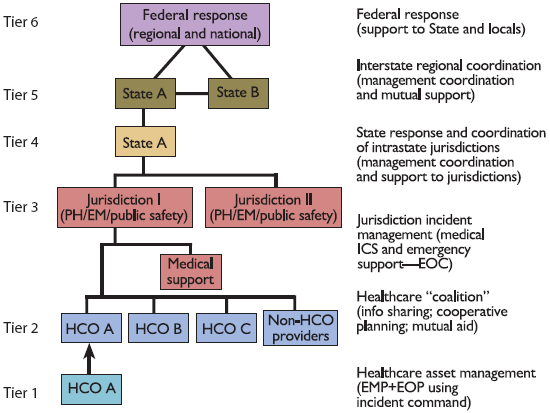
The tiered model presented in the MSCC Handbook (see Figure 1-1 below) demonstrates the relational arrangement of individual healthcare response assets within the local, State, regional, and Federal government construct. Each tier is summarized below.
Tier 1: Encompasses all individual healthcare organizations in a geographic area that deliver "point of service" medical care during emergencies or disasters.
Tier 2: Tier 1 assets that have formed a Healthcare Coalition to share incident information, exchange resource status information that supports mutual aid, coordinate response strategies and tactics, and use a common interface with local jurisdictional authorities to exchange information and request assistance.
Tier 3: Municipal, county, or similar agencies with jurisdiction over the impacted areas and responsibility for the local government response. They are referred to as "Jurisdictional Agencies" throughout this handbook.
Tier 4: State-level response that supports Tiers 1-3 by managing statewide and sub-State regional coordination of the healthcare response.
Tier 5: State-level response that manages inter-State regional coordination of response to support Tiers 1-3 healthcare response assets.
Tier 6: Federal assistance to State, Tribal, local, and non-governmental healthcare response at Tiers 1-5, as managed through a Joint Field Office and/or other Federal coordinating center.
Figure 1-1. MSCC Management Organization Strategy
The tiered model demonstrates the relational arrangement of individual healthcare response assets within the local, State, regional, and Federal government construct. It is described in the preceding paragraph.
A Healthcare Coalition is a group of healthcare organizations in a specified geographic area that agree to work together to enhance their response to emergencies or disasters. The response objectives of the Coalition will vary depending on how the Coalition is constructed in a particular area. Example objectives include promoting situational awareness, facilitating resource sharing, and coordinating response actions among its member organizations. The Coalition also promotes the efficient interface of its member organizations with jurisdictional authorities (Tier 3). As noted earlier, the Coalition serves as a coordinating entity during incident response; it does not supplant the relevant incident command authority.
The Healthcare Coalition has both a preparedness and a response element. The response element is described in Chapters 2-4 of this handbook, while the preparedness element is discussed in Chapters 5-7. The Coalition response element is presented first to provide the reader with a clear understanding of the end goal for the Healthcare Coalition preparedness program.
A major focus of NIMS is on preparedness. Many organizations are involved in initiatives to enhance preparedness within and across levels of government. These initiatives often rely on committee meetings, teleconferences, and e-mail communications. Hospital associations, EMS councils, non-profit organizations, local emergency planning committees (LEPC), and public health/public safety agencies have all served as coordinating mechanisms for preparedness.[18] While these platforms, which are generally referred to in NIMS as "preparedness organizations" (see Exhibit 1-4), can be effective for preparedness planning, they can be problematic if used for emergency response due to their non-emergency nature and lack of 24/7 availability.
Exhibit 1-4. Definition of a Preparedness Organization
According to NIMS, a preparedness organization "provides coordination for emergency management and incident response activities before a potential incident. These organizations range from groups of individuals to small committees to large standing organizations that represent a wide variety of committees, planning groups, and other organizations (e.g., Citizen Corps, Local Emergency Planning Committees, Critical Infrastructure Sector Coordinating Councils).
U.S. Department of Homeland Security, National Incident Management System (NIMS), December 18, 2008.
For healthcare planners and participants in a Healthcare Coalition, it is important to distinguish the Coalition's "preparedness organization" from the "response organization" that is needed for emergency response and recovery (Exhibit 1-5). The latter uses the structure and processes required to "get things done" under emergency conditions.
NIMS does not define a response organization, instead focusing on the ICS organization that commands incident response. However, the National Response Framework (NRF) uses "response organization" as the title of a chapter that highlights the importance of understanding "how we as a Nation are organized to implement response actions."[19]
It emphasizes the need to define how an organization will be configured to effectively manage its emergency response. Exhibit 1-5 highlights the contrast between a preparedness and a response organization.
Exhibit 1-5. Preparedness versus Response Organization
Preparedness Organization:
Provides a structure and function to manage the coordination of emergency management activities, which take place in a non-emergency context.
Conducts emergency management program activities, including committee meetings, EOP development, preparedness planning, training, exercises, resource management, and program evaluation and improvement.
Response Organization:
Provides a structure and function to manage the coordination of actions to achieve objectives under emergency conditions.
Conducts information management, emergency decision-making, incident planning, actions to implement decisions, and coordination of resources.
According to NIMS, "the primary function of a MAC System is to coordinate activities above the field level and to prioritize the incident demands for critical or competing resources, thereby assisting the coordination of the operations in the field."[20] A common example of a MAC System is the traditional local jurisdiction or State Emergency Operations Center (EOC), which provides high-level support to the incident command entities. The MAC System coordinates the various organizations that are supporting the Incident Management Team (IMT). Since this is the intended function for the Healthcare Coalition, MAC System concepts should be understood by Coalition planners.
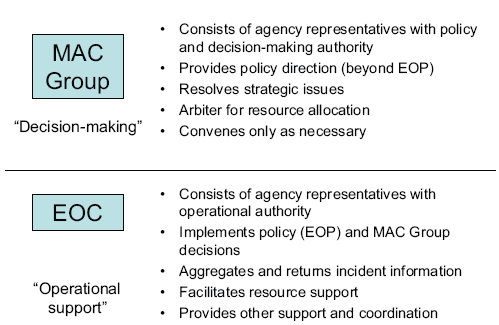
A MAC System can consist of a range of elements, but the most commonly referenced are the EOC and the Multiagency Coordination Group (MAC Group). Figure 1-2 highlights the contrast between the MAC Group and the EOC.
Figure 1-2. Comparison of the Central Elements of the MAC System
Figure 1-2 highlights the contrast between the MAC Group and the EOC.
MAC Group, "decision-making," consists of agency representatives with policy and decision-making authority; provides policy direction (beyond EOP); resolves strategic issues; is the arbiter for resource allocation; and convenes only as necessary.
EOC, "operational support," consists of agency representatives with operational authority; implements policy (EOP) and MAC Group decisions; aggregates and returns incident information; facilitates resource support; provides other support and coordination.
While other models may be considered for the Healthcare Coalition response organization, the concepts inherent to a MAC System – specifically the EOC function and the MAC Group – are widely accepted and validated. They also conform to the national mandate that response organizations use NIMS principles. NIMS recognizes that these concepts are flexible and may be applied in the private sector.
1.5 The MSCC Healthcare Coalition as a MAC System
Applying MAC System concepts, the Healthcare Coalition response organization has two major components:
The MAC Center[21] or EOC-like function (referred to in this text as the Healthcare Coalition Response Team or HCRT), which is generally staffed with personnel from the participating healthcare organizations.
The MAC Group (referred to in this handbook as the Senior Policy Group) representing the leadership of the participating healthcare organizations.
The actual titles "Healthcare Coalition Response Team" and "Senior Policy Group" may vary from one Coalition to the next, but they should accurately reflect the respective roles of these components. Healthcare Coalitions may want to avoid using "EOC" in the title of their response organization in order to distinguish this EOC-like function from local jurisdiction (Tier 3) and State (Tier 4) response elements. The term EOC, as defined by NIMS, also describes a physical location rather than simply a functional entity. Typically, the HCRT may have a very small primary physical location. Most of its work may be conducted by team members who remain at their "home" facility and communicate virtually.
9. Adapted from Ansell J, and Wharton F. Risk: Analysis, Assessment, and Management. John Wiley & Sons, Chichester, 1992.
10. Drabek TE, Hoetmer GJ (Eds). Emergency Management: Principles and Practice for Local Government. International City Management Association, Washington, D.C.; (1991).
11. Within this text, casualty refers to any human accessing public health or medical services, including mental health services and medical forensics/mortuary care (for fatalities), as a result of a hazard impact.
12. Within this text, incident refers to any unexpected situation that requires an organization to activate its Emergency Operations Plan and commence emergency response operations. NIMS designates a planned non-emergency situation (e.g., a mass gathering) that activates emergency operations as an "event."
13. Barbera JA, Macintyre AG, Shaw G, et al, Emergency Management Principles and Practices for Healthcare Systems (2006). 14. Chapter 5 provides more detail on applying a systems-based approach during design and implementation of a Healthcare Coalition.
15. Jurisdictional Agency is the NIMS term referring to the "agency having jurisdiction" and responsibility for a specific geographical area or mandated function. Usually, this is a public agency representing a local, State, or Federal government that has direct authority for emergency response and recovery (NIMS, December 18, 2008).
16. The National Incident Management System (NIMS) and related guidance.
17. Additional information on NIMS implementation guidance for healthcare organizations.
18. Maldin-Morgenthau B, Toner E, Waldhorn R, et al, Roundtable: Promoting Partnerships for Regional Healthcare Preparedness and Response. Biosecurity and Bioterrorism: Biodefense Strategy, Practice, and Science, Volume 5; 2007.
19. U.S. Department of Homeland Security, National Response Framework (January 2008).
20. NIMS Component IV: Command and Management, Section B. Multiagency Coordination Systems. The NIMS definition of a MAC System is provided in Appendix B.
21. In the original NIMS (March 2004), the EOC and DOC-type entities were referred to as a "Multiagency Coordination Centers."